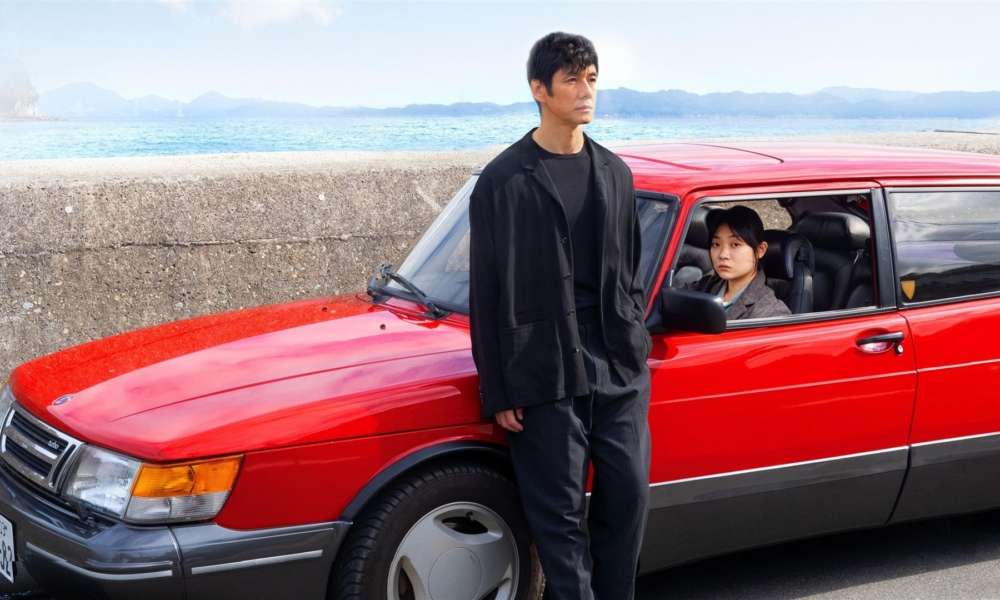

Why a car? The last metaphor that would have been suitable to encapsulate Yusuke Kafuku’s (Hidetoshi Nishijima) life’s dilemma, is a car. The most unfortunate experiences he went through, his car went through with him. As a stage actor and director Yusuke has the heart of an artist and in his heart he carries grief. Torn apart by her wife Otto’s sudden death by a cerebral hemorrhage, Drive My Car takes Murakami’s subtle storytelling to another level.
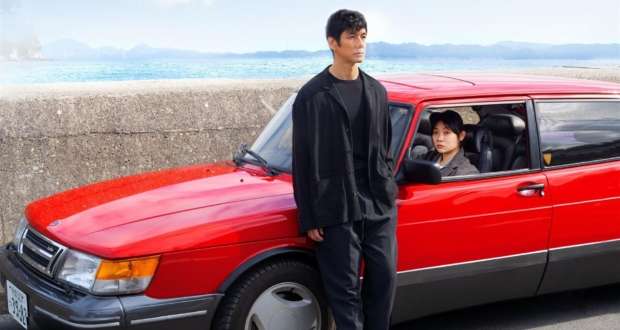
The trauma however, came coupled with her infidelity which he ignores on purpose and its accountability dies with her. So the grief became something else. Something which remains all over the place. So Yusuke compartmentalizes it in his red SAAB 900 Turbo. His sadness remains mobile. Wherever he goes, it goes with him.
The Car as a Heterotopia of Suffering
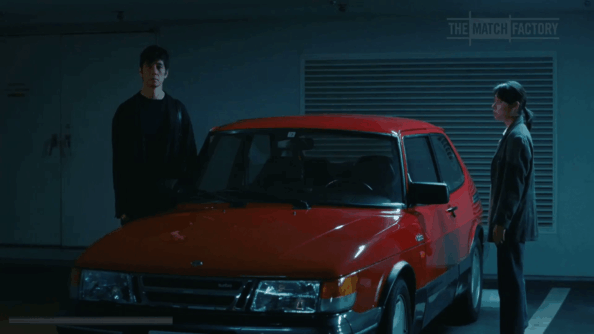
Philosopher Michel Foucault came up with the term heterotopia referring to physical spaces where rules of time and life do not apply. To exemplify that, think of a ship. A floating body elsewhere, atypical from the regular spaces. A cemetery where life and death coexist. Or a hotel room where life exists temporarily and anonymously. Yusuke’s red SAAB is also a heterotopia of space. It is the place where he plays the voice of his dead wife, the epicenter of his trauma. He is neither healed nor fully broken as long as he stays within the car.
The tapes he plays of the theatrical play Uncle Vanya is also Chekhov’s realistic portrayal of life, a theme prevalent overall in the film. This enclosed space therefore, becomes Yusuke’s suffering encapsulated. Despite it, Yusuke remains happier within the car than the outside world. Driving his own car becomes his avoidance coping.
Otto’s voice is still there, so it remains present. He is rehearsing with his lines, so he’s not in the future but in a heterotopic zone where he is fully in control. Outside this world, he cannot direct the actors comfortably, he cannot confront his wife anymore, and he cannot listen to Otto’s voice.
Stanislavski’s Method Acting and Chekhov’s Uncle Vanya
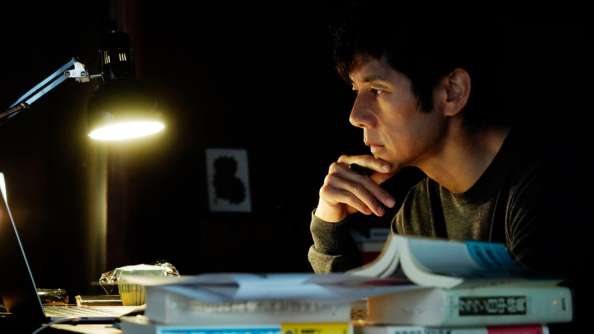
Drive My Car finds its authenticity in its approach to the theatrics of storytelling and how artists grapple with loss. Ryusuke Hamaguchi sketches it on screen through the devices employed by artists in their niche spaces and respective worlds. Konstantin Stanislavski introduced what in modern terms is called ‘method acting’. Through the technique of emotional memory, actors tend to recall their emotionally scarred experiences and bring the emotional expressions on stage. Yusuke manipulates this strategy as an artist to repress this trauma rather than arouse it.
A core subnarrative here is Yusuke’s refusal to play Vanya. He knows that the role will implicitly unearth the damage of his pasts and make him sit in a room with his wife’s ghost. More than anything he carries Vanya with him like a shadow and embracing him would mean becoming him and abandoning the comfort of his shadow which followed him for ages.
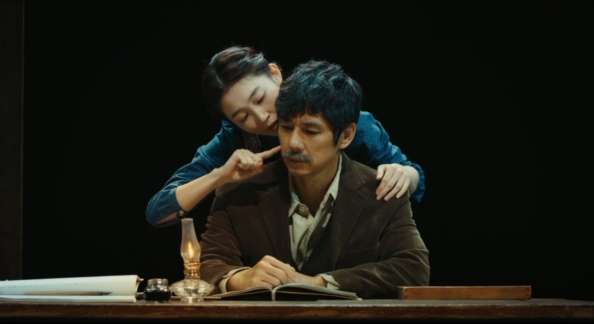
He also, in the back of his head, knows that he is Vanya. Chekhov’s Vanya spends his entire life managing a retired professor’s estate only to find out in middle age that his devotion is futile. Yelena, whom he loves, doesn’t love him back. This leaves him suicidal which is exactly what Yusuke wants to avoid. He assumes he mirrors Vanya. He spent his life chasing something which in the long run turned out to be meaningless.
He also feels betrayed by his wife and knows how he will never be able to confront her again. Relying on his reversed method of emotional memory, he intellectualizes his grief. The intellectualizer feels nothing often retreating to abstract logic and quietly observing other than feeling it completely. He sits in theaters night after night and watches other actors perform a play about him, refraining to become and eager to observe.
The Passenger As a Co-regulatory Figure
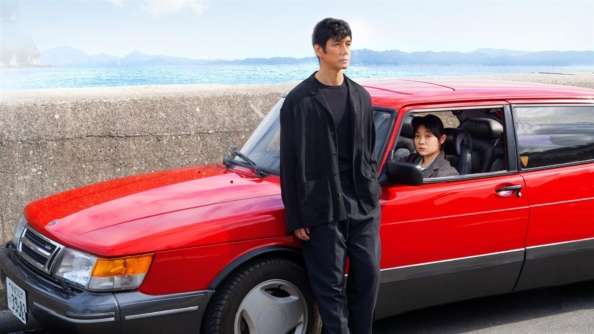
Working as a casting director with an agency, Yusuke is assigned a young female driver named Misaki Watari (Toko Miura). Though reluctant to become a passenger in his own car at first, Yusuke eventually gets comfortable in her presence. By the end of the film, the two form a bond that transcends the limitations of a label. Misaki, in the past, has also endured a wound which is still fresh and cuts her deep to this day. Her unresolved trauma becomes a mirror to Yusuke and later in the film we learn that the car she drives acts as a heterotopic cage for her too.
Misaki shares how her abusive mother would strike her if she won’t drive smoothly and later on loses her in a house fire. She also has a burned scar on her face which foreshadows her experience of some tragic event. She drives Yusuke to the municipal garbage dump in Hokkaido where the two of them open up about their past grievances. They share their unfinished tales of misery which is holding them back from moving on in their lives.
But why a garbage dump?
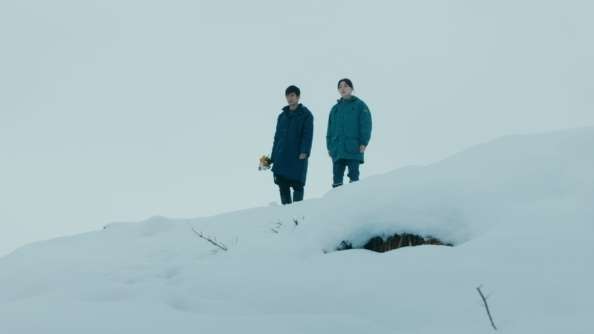
The dump is also the place where Misaki’s house collapsed in a fire. Re-visiting the place makes it easier for her to confess. Moreover, a garbage dump is a place so alienated, isolated, and socially insignificant but it is still not the red SAAB where the two of them feel entrapped. It is the most ordinary space where nobody comes or only visits when they want to get rid of something. The two of them go there to dump their pain and suffering. Yusuke confesses that he wanted to kill his wife when he found out that she betrayed him. Mizaki tells him how she felt relieved when her mother died in the house fire. Two psychologically dysfunctional nervous systems calm each other down, co-regulating through mutual unspoken knowledge of grief. Grief also tends to reside in cracks, often inexplicable and thus hard to communicate. The feeling, henceforth, of its perception is nothing less than a blessing.
By the end of the film, both Yusuke and Misaki have healed. Yusuke finally accepts to let go after the cathartic confession and plays Vanya once again on stage. He also gives his red SAAB to Misaki as his final act of embracing emancipation. Misaki is healed because she accepts the red SAAB and can now drive freely without the fear of getting hurt, however she wills.
Happy Watching!