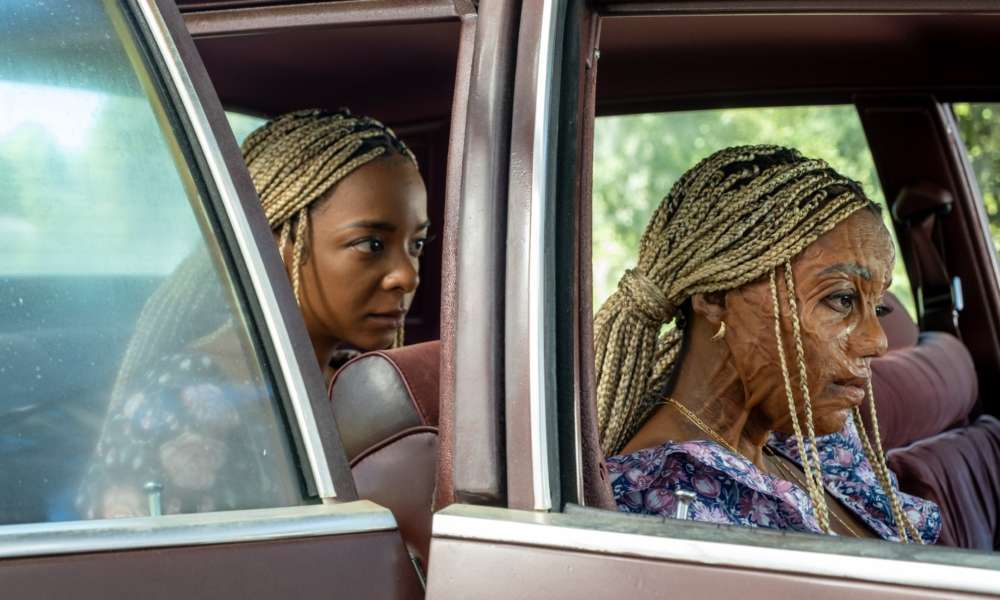

Before Is God Is becomes a revenge thriller, a Southern Gothic fever dream, or a mythic road movie with blood on its boots, it is a story about two sisters. That is the part that gives the film its heartbeat.
Racine and Anaia are not just partners on a violent mission. They are survivors who built a life around protecting each other from a world that has already done enough damage. Their journey may be fueled by revenge, but their bond is what keeps the story from becoming just another stylish ride into chaos.
Aleshea Harris understands that sisterhood is not always soft. Sometimes it is tender. Sometimes it is tense. Sometimes it is two people arguing in a car while still being the only thing keeping each other alive.
That is what makes Racine and Anaia feel so real.
Racine and Anaia Against the World

The twins begin the story inside a small world they have made for themselves. It is not perfect, but it is theirs. Their apartment becomes a kind of shelter from the stares, judgments, and wounds waiting outside.
That shared space matters because it shows us something important before the revenge plot takes over. These sisters have already survived the worst night of their lives. They have already carried scars, both visible and hidden. They have already learned how cruel the world can be.
So when their mother, Ruby, sends them on a mission to find their father and make him answer for what he did, the story does not simply become about revenge. It becomes about what revenge might cost the only relationship they have left.
Two Sisters, Two Survival Languages
Racine and Anaia are connected, but they are not the same. That difference gives the film much of its tension.
Racine: The Fire That Keeps Burning
Racine is forward motion. She is anger with a destination. She carries herself like someone who decided long ago that fear was not going to run the house anymore. She is protective, aggressive, and often impulsive. However, underneath all that force is love. Racine does not push Anaia because she does not care. She pushes because she believes movement is survival. To Racine, doing nothing feels like surrender.
Anaia: The Silence That Still Speaks
Anaia carries trauma differently. She is quieter, more cautious, and more aware of how dangerous rage can become once it gets behind the wheel. Her scars may be more visible, but her inner life is just as powerful. She dreams, fears, questions, and resists. She is not weak. She is someone who has learned to survive by measuring every step. That contrast makes the sisters compelling. Racine wants to charge forward. Anaia understands that fire can burn the person holding it too.
The Real Love Story Is Between Sisters
For all the violence and wild genre swings in Is God Is, the emotional center is the love between Racine and Anaia. Not a clean, greeting-card kind of love either.This is lived-in love. The kind with frustration, shorthand, side-eyes, loyalty, and history. The kind where one sister can get on your last nerve, but let somebody else try her and suddenly it is a family emergency.
That dynamic gives the movie its soul. The revenge mission may send them across different worlds, but every new stop tests the same question: Can these sisters hold on to each other while walking deeper into the pain that shaped them? That is where the film becomes more than plot.
Sisterhood Built Through Process
One of the strongest behind-the-scenes details is how the production built the sisters’ bond before filming. Kara Young and Mallori Johnson worked with movement specialist Raja Feather Kelly to develop a shared physical language. They moved together, played exercises, and worked on feeling like two separate people who could still function as one unit. That kind of preparation matters.
The chemistry works because the production treated sisterhood like choreography.
It was not just about memorizing lines or matching emotional beats. It was about rhythm. Space. Trust. Timing. The little invisible things that make two people feel like they have known each other longer than the camera has. That preparation shows onscreen. Racine and Anaia do not just talk like sisters. They move like sisters. They react like sisters. They carry the weight of shared history even when they are standing in silence.
Black Sisterhood as Epic Myth
Hollywood often treats Black sisterhood as support work. One woman hurts, and another woman shows up to comfort her. One woman struggles, and another woman helps her heal. Those stories can be meaningful, but they can also become limiting. Is God Is gives Black sisterhood a much bigger frame.
Here, sisterhood is mythic. It is tragic. It is funny. It is violent. It is sacred. It is messy. Racine and Anaia are not side characters in someone else’s legend. They are the legend. That choice matters because Harris places Black women inside a story that pulls from Greek tragedy, folklore, westerns, and surreal revenge cinema. The sisters are not being squeezed into a familiar mold. They are reshaping the mold around themselves.
That is what makes the film feel so bold.
Why Racine and Anaia Stay With You
The revenge in Is God Is may grab attention, but the sisterhood is what lingers. Racine and Anaia are not perfect survivors. They hurt. They clash. They make choices that may leave audiences arguing on the ride home. But that is also what makes them interesting. They are not symbols of resilience polished up for easy applause. They are people trying to survive what was handed to them, while trying not to lose the only person who fully understands the wound.
For all the blood, fire, humor, and madness inside Is God Is, the film keeps returning to one truth: Racine and Anaia survive because neither one is willing to let the other disappear. That is the real fight. And that is what stays with you after the credits roll.