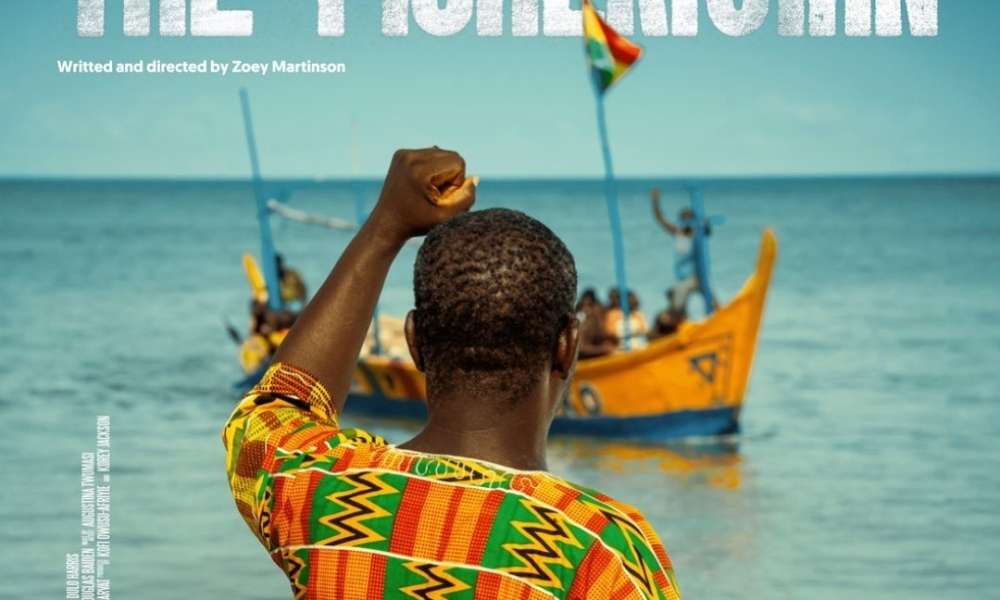

I went into The Fisherman expecting a quiet fable. I walked out smiling, a little misty, and thinking about how money, memory, and technology tug at families in real time. The film is set within a Ghanaian fishing community and uses a talking fish to crack open change. That sounds wild on paper. In the room, it lands with warmth, wit, and a magic realist touch that feels earned.
First impressions in the dark
The opening creation beat hooked me. The kids are funny, and the comedy style keeps the tone buoyant even as the story pokes at tradition. Our lead is stubborn in the way that feels familiar. He distrusts cell phones, side-eyes new gadgets, and still measures success by feel and tide. Then the film throws him a curve. A talking fish arrives and starts nudging him toward a new life.
“When you realize you lack nothing, the whole world opens up to you.”
That was my note to self as the story unfolded. The movie is not only about one man’s growth. It is also about how his choices ripple through his circle, especially his daughter Naa. There is a tender thread about identity and how love adapts when the person you love evolves.
Money on the line
Technology creeps into the work. It becomes a rival to experience. A fish finder can promise certainty, yet the sea still answers to respect and rhythm. There is a wry sequence where salted fish becomes quick capital. The laugh lands, but the point is clear. People hustle because dreams cost. The bank scenes underline that pressure. A loan offers hope. It also tests whose dream is on the paperwork.
The film keeps finding humor in these pivots. Someone cracks a line when the power cuts. “This is not Nigeria.” The room howled. It is a playful jab that also signals pride. The joke does not punch down. It winks at regional rivalry while the story keeps its heart on the people in front of us.
The talkback: how a short became a feature

After the ABFF Pop Up NYC screening, director Zoey Martinson and producer Corey shared the origin story. The project began as a short when demolition threatened a historic fishing district near Accra. Festivals embraced the short, and the question kept coming. Where is the larger story. During the writers strike, the team submitted an outline to a lab in Venice. Acceptance came with a hard clock. The script had to arrive fast.
“I had to write the script in three weeks,” Martinson said, laughing at the memory. Notes flew back and forth while pages arrived at speed. The expansion deepened characters and added new ones, but the tone stayed key. Some advisers pushed for heavier drama. Martinson resisted that pull.
“Yes, people struggle. But day to day, there is humor. I wanted that truth on screen.”
Comedy here is not sugar. It is culture. The laughter lets harder ideas in without turning the people into case studies. The choice works. The audience in New York met the characters with affection, not pity.
Ghana as character
Both artists spoke about the country with care. Martinson described a period of loss that sent her to Ghana as a teen. Life there taught her stillness and attention. She learned to see the routine as art. Nets rise. Voices trade stories. Hands move with muscle memory. That rhythm sits inside the film. Corey pointed to the coast as a production challenge and a gift. Travel was long. The payoff was texture. The sea, the docks, and the streets frame every choice the characters make.

One moment from the talkback stays with me. The team found time to visit Cape Coast Castle and walk through the Door of Return. “Welcome back” hits different when you hear it on that ground. The film does not stop for a lecture. It carries that history in its gait, then lets the community on screen stand tall.
The fish, the family, and the future
The fish is named Koobi. The name hints at salt and preservation. I read it as a bridge. The fish speaks, but it also listens. It pushes the lead to accept help, trust the next wave, and share power on the boat. My notes turn into questions here. Is the goal to buy a boat truly his dream. Or is he holding on because change is scary. When the family wins, who gets to steer. The film answers with grace. It honors elders and still makes room for the next captain.
“It is not only his growth. It is the growth he inspires.” That line sat at the top of my page by the end. The final beats reframe success as community health. Titles change. Pride shifts. Love remains.
This is a beautiful film to look at. The camera treats faces like landscapes. Sun on skin. Salt in hair. The TikTok gag killed in the theater. The edit keeps the pace light, and the score slides in under jokes without elbowing them. Performances sell the tone. The lead is stubborn and soft at once. The young actors regularly sneak in steals with timing and eyes.
What I carried out of the theater
I left thinking about work, worth, and how families choose leaders. I also left hungry because someone cooked koobi in one scene and the seasoning looked elite. But mostly I felt grateful. Stories like this remind us that joy survives pressure. Change meets you on the shore. You can meet it with fear. Or you can meet it with a grin and a good plan.
“The Black creative economy is not emerging. It is expanding.” That line from my earlier ABFF coverage fits here. The Fisherman shows why. It values skill, honors history, and lets a talking fish tell the truth.