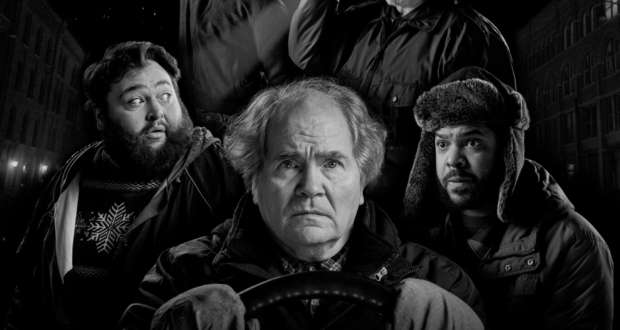
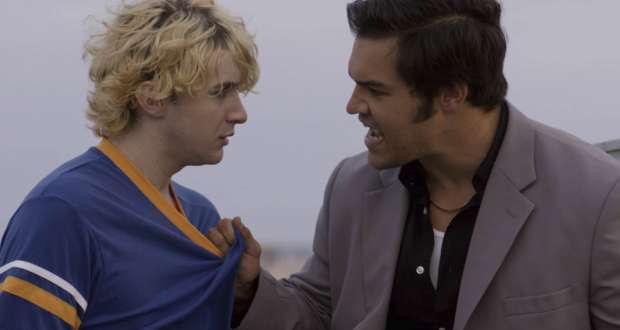
Blurring mesmerically the line between performance and reality, the intense drama “Yes Repeat No” is designed to make us think about our world. The past. The present. And a dream for our future. TMB’s John Smistad talks with Director and Writer Michael Moshe Dahan.
Filmmaker Michael Moshe Dahan’s First Dramatic Feature
Dahan has helmed a short film and a rock music documentary previously. “Yes Repeat No”, his first foray into dramatic filmmaking, finds him going all in as writer, director and co-producer.
Plot Summary
“Yes Repeat No” explores the complexity of the overlapping identities of Juliano Mer-Khamis, a Palestinian Jew who was assassinated on the steps of the theatre he’d founded in Jenin.
Mer-Khamis considered himself a living embodiment of the Palestine-Israel conflict. Born to an Anti-Zionist Jewish mother and a Palestinian Christian Communist father, Mer-Khamis became an internationally acclaimed actor who appeared in films including “The Little Drummer Girl” (1984) and “Miral” (2010). Later becoming a director, theater founder and political activist, he considered himself a living embodiment of the Palestine-Israel conflict. Though code-switching between the conflicting identities he inhabited, Mer-Khamis understood he was always viewed as an Arab in Israel, and a Jew in Jenin.
“Yes Repeat No” asks whether it is remembering our past–or, instead, forgetting it— that allows us to break cycles of identity and conflict.
More about Michael Moshe Dahan
Dahan is an Israeli-American scholar, filmmaker, and artist who earned his MFA in Studio Art with a Critical Theory Emphasis from UC Irvine in 2012. His current work interrogates the entwined legacies of descendants of victims and perpetrators of the Nakba and considers the transmission of such phantasmatic legacies across generations. His experimental film, “Two Points of Failure”, was screened at the Rotterdam, Edinburgh, Jihlava, Bucharest, and Melbourne International Film Festivals, as well as the Tribeca Film Festival and the MAK Center for Art and Architecture in Los Angeles. Before receiving his MFA, he spent a decade working as a film executive.