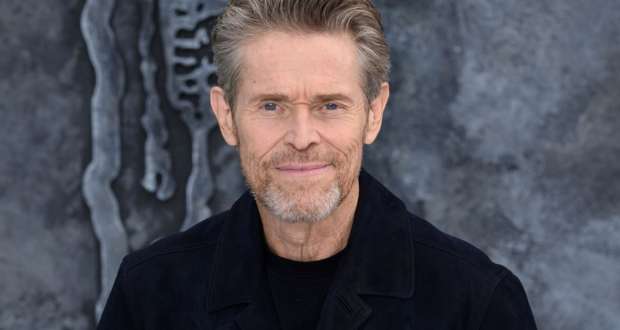
A retrospective of Kelly Reichardt’s films is one of the highlights of the 61st Chicago International Film Festival ongoing now through October 26th. Reichardt has won awards at Cannes, Lucarno, London and Rotterdam. “First Cow” (2020) is one with which I was familiar, but I’ll be going back to “Old Joy” (2006) and “Showing Up.” Reichardt’s latest film, “The Mastermind,” opened October 17th.
“THE MASTERMIND” PLOT
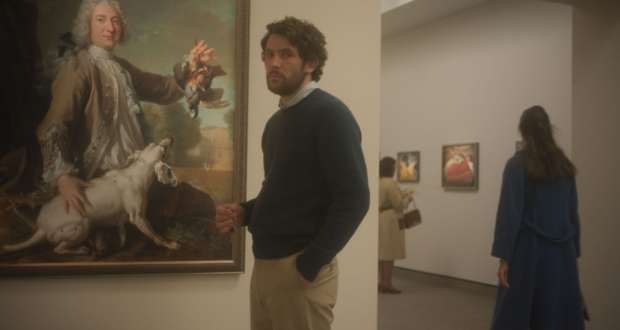
Set in 1970 in Framingham, Massachusetts, we follow James Blaine Mooney (Josh O’Connor, “Challengers”), art school dropout, unemployed would-be carpenter, father of two young boys and husband to the long-suffering Terri (Alana Haim) as J.B. masterminds the heist of four valuable Arthur Dove modernist paintings from the Framingham Art Museum.
James enlists three accomplices, a rag-tag gang of small-time thugs, played by Eli Gelb (Guy Hickey), Cole Doman (Larry Duffy) and Javion Allen (Ronnie Gibson). The group could serve as the cast of The Gang Who Couldn’t Shoot Straight. A late replacement in the trio, when the driver bails, Ronnie, turns out to be particularly unreliable. He brings a gun when told not to and, soon after the art heist, holds up a bank. When caught, Ronnie Gibson (Javion Allen) immediately gives up the entire group. James leaves town and is on the run for most of the rest of the movie (and possibly for the rest of his life.)
INSPIRATION

Kelly Reichardt wrote and directed “The Mastermind,” now open in theaters, which screened at the 61st Chicago International Film Festival where she was honored with a Retrospective of her films.
“It’s an aftermath film, an unraveling film,” said Reichardt, its Writer/Director. She underscores the reality that actions have consequences and continues focusing on characters at a crossroads in their lives who are often on the fringes of society. “In the 90s I thought about doing an art heist film on Super-8,” Reichardt remembers, “so it’s been cooking in the back of my mind for a long time. A couple of years ago, I came across an article about the fiftieth anniversary of this art heist at the Worcester Art Museum in Massachusetts, where some teen girls got swept up in the robbery. That was a fun image and was kind of the first seed.” Locally legendary, that event took place on the afternoon of May 17, 1972, when armed men pilfered two Gaugins, a Rembrandt, and a Picasso.
Thematically, the plot reminded of the 2018 Evan Peters/Barry Keoghan Sundance vehicle “American Animals,” written and directed by Bart Layton that also had a clueless band of thieves who ripped off a museum. Said one of the real thieves featured in that 2018 film, Warren Lipka : “You’re taught your entire life that what you do matters and that you’re special. And that there are things you can point towards that would… which’ll show that you’re special, that show you’re different, when, in all reality, those things… don’t matter. And you’re not special.” Much of that “American Animals” philosophy shows up in Reichardt’s examination of another botched robbery and the motivation behind it.
THE MUSEUM
The film opens with James escorting his family through the Framingham Art Museum, where he is a frequent visitor and pilfering a small object. In reality, there is no Framingham Art Museum. “Tony Gasparro and the art team built the interior of the museum from the ground up in an old warehouse,” Reichardt said. For the museum’s exterior scenes, Reichardt’s team shot at the Cleo Rogers Memorial Library in Columbus, Indiana. Completed in 1969, the facility was designed by architect I. M. Pei with an eye to revitalizing the town’s center.
JAMES BLAINE MOONEY
James Blaine is unemployed and has a generally entitled attitude, as his father—well played by Bill Camp—is Judge Bill Mooney. The would-be “mastermind” seems to have had a respectable middle-class upbringing, making his decision to become a criminal even more interesting. The family dynamic is central to the film. The actors portraying J.B.’s two young sons, Tommy and Carl are well-played by two fraternal twins from Louisville, Kentucky, Jasper (Tommy) and Sterling Thompson (Carl). “They’re twins, but they are different boys with very different personalities.”
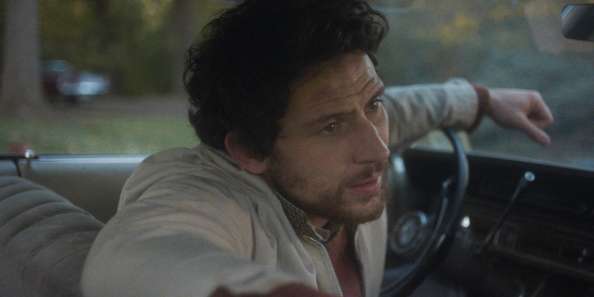
Josh O’Connor in “The Mastermind.”
Both boys were hilarious and excellent in their roles. One of the best lines from the film may be at the conclusion of one hellacious day, when J.B. is abducted by three thugs and leaves Tommy alone in the family car. Upon his return, he says, “Let’s keep today to ourselves.” I laughed out loud, as Tommy has entertained himself for a very long time while wondering, I’m sure, why those men took his dad and what is going on? Said Reichardt, “It’s a heist movie, in a sense, but the family and friend dynamics are kind of the main thing. Mooney is blowing up his world and the heist is how he goes about it, consciously or unconsciously.”
MURPHY’S LAW
The entire robbery represents a life lesson in Murphy’s Law where, if anything can go wrong, it will go wrong. The plot can be summed up with this scripted line from Guy Hickey (Eli Gelb) said to would-be mastermind J.B., “Honestly, I don’t think you thought things through enough.”
That line is a major understatement. J.B. was somehow involved with fencing the stolen paintings through his association with former art school Professor Pruitt, but the entire fiasco goes up in flames almost before it even gets underway, beginning with the defection of get-away driver Larry (Cole Doman).
FAVORITE SCENE
My favorite sequence among many good ones was watching James Blaine hauling the paintings, one-by-one, up a ladder to the loft of a barn, to hide them. Then somehow, while a hog is shown rooting around beneath the ladder, J.B. manages to knock the ladder over so that getting down (after 4 or 5 trips up the ladder with each individual painting) becomes a logistical nightmare. Keeping the paintings proves even more difficult than stealing them; J.B. has the paintings taken from him by three large gangster types. Mooney goes on the run, first stopping in the countryside where old friend Fred (John Magaro, “The Big Short”) and wife Maude (Gaby Hoffmann, “Field of Dreams”) give him temporary lodging.
Maude gardens and Fred (John Magaro, “The Big Short”) works as a substitute teacher at the local middle school. Fred is star-struck at the thought that his childhood friend, whom, he says, used to “nibble around the edges” of crossing society’s lines has now, in his own life, “blown it up.” Fred seems quite impressed with news coverage of his old buddy’s exploits, which Maude finds upsetting. Fred suggests that J.B. might want to think about a commune in Canada only 58 miles across the Canadian border as his hide-away, joining Fred’s own draft-dodging brother.
There is the 70s theme of conscription into the war in Vietnam, one which my own spouse narrowly avoided only because of my pregnancy at the time. (Scripted line from a member of the commune: “I got to Paris Island and things got real.”) My generation remembers Vietnam well. My children and grandchildren, of course, do not and have only news reels for historical placement. Maude approaches James privately. She tells him bluntly to move on and never contact her husband again, saying, “I don’t want you ruining our lives, too.”
J.B. takes off for Cincinnati and, ultimately, for Canada. He plans to join a group that Fred described to him as seventies dissidents, druggies, draft dodgers: “You know, nice people on the run.” We hear James Blaine calling home on the phone during his escape, once again asking for a financial hand-out from someone (in this case, not his Mom Sarah but his wife). Once again, we wonder why Terri Mooney doesn’t give her MIA spouse a World Class chewing-out—especially when he protests, “Everything I’ve done was for the good of our family.” Terri remains silent.
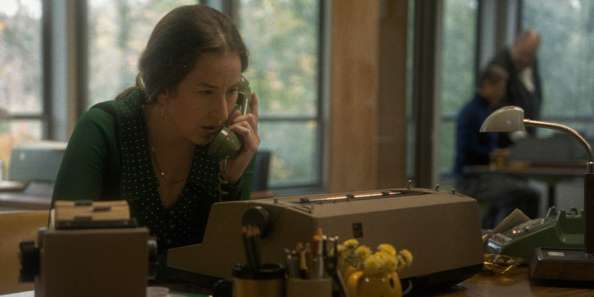
Wife Terri Mooney (Alana Haim) doesn’t speak up about her husband’s shortcomings when he phones from the road, and one wonders why.
CAST & CREW
Reichardt often works with many of the same actors. She has cast some very recognizable and seasoned actors and actresses in “The Mastermind. In addition to Bill Camp and Gaby Hoffmann, you’ll recognize Amanda Plummer (“Pulp Fiction”) as Louise and Hope Davis (“Synecdoche, New York”, 2002; “About Schmidt”, 2008) as J.B.’s Mom Sarah. These are proficient character actors film-goers will recognize from decades of past excellent work.
Cinematographer Christopher Blauvelt has provided great camera work for the production. The musical score by Rob Mazurek—(which, at one point, was random acoustical percussion noises)—also adds to the overall mood and augments Reichardt’s directing and writing.
CONCLUSION
Reichardt has crafted an engrossing look at a loser who has outdone himself this time. The film ends with a whimper, not a bang. As Reichardt put it, “James Blaine is a man smart enough to get into trouble, but not smart enough to get out of it.” An observation by the director of “American Animals”, Layton, another art heist movie, applies to the lead character of James Blaine Mooney, psychologically. Layton said he felt that, “We’re increasingly in a culture where we’re all under huge pressure to be special. Being successful is not enough. There is pressure to not be a failure. No one wants to be ordinary.” He felt that Spencer, the mastermind in American Animals, “destroyed his life from the inside out, to have something to say.”
Watch for it if/when it plays or streams near you. It will give film buffs who enjoy a thinking man’s movie—a sort of “70s throwback”—a nice alternative to the “spandex movies” (William Friedkin’s term) that dominate new studio releases. You’ll enjoy talking about this one after the final scene fades.