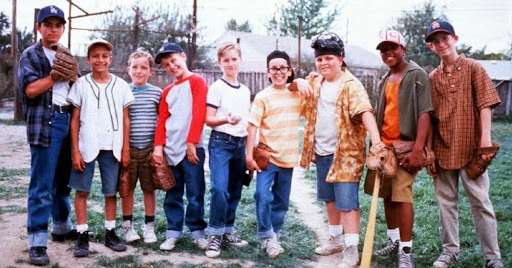

Few movies capture the magic of growing up quite like The Sandlot. Released in 1993, it’s more than a baseball story, it’s a love letter to summer, friendship, and the American pasttime. Three decades later, it still resonates because it celebrates the things that never age such as belonging, imagination, and the simple joy of play.
A Summer Every Kid Dreamed Of
Set in the early 1960s, The Sandlot follows Scotty Smalls, a shy boy who moves to a new town and finds acceptance through a group of kids who play baseball every day in a dusty neighborhood field. Their adventures stretch far beyond the game though. Sneaking into the pool, facing down “The Beast,” and discovering the thrill of camaraderie.
What makes the movie special isn’t the baseball but the bond between the boys. Director David Mickey Evans captured the rhythm of a lazy summer, where each day feels endless and every small victory feels monumental. The film is nostalgic but never overly sentimental. It remembers childhood not as perfect but as precious precisely because it was messy and unpredictable.
When Smalls finally catches the ball and earns his place among the others, it’s one of the most satisfying moments in family cinema. The scene isn’t about winning, it’s about belonging. That universal feeling continues to resonate across generations.
More Than a Baseball Movie
While The Sandlot revolves around baseball, it transcends the sport. It’s really about community, courage, and the awkward steps toward growing up. Often compared to Stand by Me, both films explore friendship and nostalgia through the lens of memory. But where Stand by Me dwells on loss, The Sandlot celebrates joy. The laughter, risk, and discovery that define being young.
The boys’ makeshift field is the heart of their world. It may be small and dusty, but to them it’s Yankee Stadium. That ability to turn something ordinary into something extraordinary is what gives the film its soul. Even Babe Ruth’s dreamlike cameo underscores this point when he tells Benny “The Jet” Rodriguez, “Heroes get remembered, but legends never die.” The moment feels less about baseball greatness and more about how childhood memories become legends in their own right.
The Sandlot vs. Modern Travel Baseball
If The Sandlot celebrates unstructured play, today’s youth baseball is its mirror image. The rise of travel teams, private coaches, and year-round tournaments has reshaped what it means to play the game. Kids now compete under the watchful eyes of adults, often in fancy matching uniforms, with schedules that rival professional athletes.
In The Sandlot, the kids play because they love it. There are no parents in the bleachers, no trophies, and certainly no pitch counts. They show up because the game is fun and the friendships matter. Their bats are mismatched, their gloves are old, and their rules are made up on the spot.
Contrast that with modern travel baseball, where 10-year-olds train four days a week, travel hundreds of miles for tournaments, and practice under bright LED lights instead of summer sunsets. Teams show up to big tournaments like Cooperstown with thousands of dollars worth of custom baseball pins and $500 titanium bats. They aren’t scavenging for a beat up old baseball to play with like in the movie.
There’s nothing wrong with ambition or structure, but The Sandlot reminds us what gets lost when sports turn into a business. When a game is turned into a “pay-to-play” industry. The film’s version of baseball belongs to the kids. In today’s world, it often belongs to the parents, coaches, and organizations.
In the movie, the boys’ only goal is to play another day. In travel baseball, the goal is to perform, to be scouted, to stand out. The local sandlot was free and spontaneous while travel baseball is costly and scheduled. Benny “The Jet” played for the love of it, not for rankings or stats. That purity is what gives the film its timeless charm.
The Power of 1960s Nostalgia
Part of The Sandlot’s enduring appeal comes from its affectionate portrayal of early 1960s America. By the time the film was released in 1993, that era had already become a symbol of innocence and simplicity. A pre-digital, pre-chaotic time when community, neighborhood friendships, and pickup games ruled the day.
The movie taps into that longing for a slower, more grounded world. The setting feels like a Norman Rockwell painting come to life. White picket fences, endless summer days, and the soft crack of a wooden bat echoing down a suburban street. The boys ride their bikes instead of staring at screens, talk face-to-face instead of texting, and find adventure in their own backyards.
For adults watching in the 1990s, The Sandlot evoked their own childhood memories. For younger generations today, it serves as a window into a time they’ve never experienced but still feel drawn to. The warm colors, vintage clothes, and classic soundtrack give the film a timeless atmosphere that makes even first-time viewers feel nostalgic. It’s not just nostalgia for baseball, it’s nostalgia for a way of life that feels lost.
That connection to the 1960s also anchors the film’s emotional core. The world of The Sandlot exists right before the cultural upheavals of the late decade, before cynicism and complexity took over American storytelling. It’s a world where kids still believed in heroes like Babe Ruth, and friendship was the most important currency. That optimism still strikes a chord with audiences who crave authenticity in an age of irony.
Why It Still Works for New Audiences
Unlike many family movies from the 1990s, The Sandlot has continued to carve out a cult following with kids. Its humor holds up, its heart remains genuine, and its themes continue to speak across generations. It doesn’t rely on flashy effects or cultural references that date it. Instead, it relies on story, emotion, and baseball in its purist form.
Parents who grew up watching it now share it with their kids, creating a rare generational connection. Children love its sense of adventure, while adults recognize the bittersweet truth of growing up and moving on. The movie bridges those experiences because it understands both.
Even visually, it remains timeless. The warm, golden cinematography, the 1960s setting, and the iconic soundtrack all create a world that feels real yet mythic. You don’t need to be a baseball fan to love The Sandlot, you just need to remember what it felt like to be a kid on a long summer afternoon.
The Legacy of a Classic
Over the years, The Sandlot has become more than a movie, it’s a piece of cultural memory. Lines like “You’re killing me, Smalls!” have entered everyday speech. The film’s legacy has grown through VHS, cable reruns, DVDs and now streaming. Turning a modest box office hit into a generational touchstone.
Sequels and spin-offs have tried to recreate its magic, but none have succeeded. The original works because it’s authentic. It doesn’t try to be epic or profound. It’s simply honest about childhood and the way time transforms ordinary days into legends.
In a world where entertainment is louder, faster, and more polished (not to mention lots of CGI), The Sandlot feels refreshingly human. Its imperfections are part of its charm. It doesn’t offer special powers or big victories, just kids, a beat up old ball, and the endless possibility of summer.
A Film That Refuses to Age
Thirty years on, The Sandlot continues to hit home because it reminds us what childhood once felt like. It celebrates friendship, adventure, and the freedom to play without fear of failure. Whether you’re a kid watching it for the first time or an adult remembering your own backyard games, it still feels like summer.
At its core, The Sandlot is a tribute to the beauty of unstructured joy. In an era where youth sports are monetized and childhood is managed, it stands as a reminder that the best games aren’t the ones with scoreboards or trophies. They’re the ones played just for the love of it.