Vince Gilligan, creator of Breaking Bad, Better Call Saul, and now Pluribus, came to SXSW on Saturday, March 14, with an all‑star group of long‑time collaborators: Rhea Seehorn, composer Dave Porter, costume designer Jennifer Bryan, and producer Trina Siopy. Together, they talked through the new series’ mysterious emotional core, the trust that holds this creative family together, and why Albuquerque keeps calling them back.
MEANING OF PLURIBUS
A surprising number of questions circled one idea: “What is Pluribus actually about?” People wanted an answer big enough to hold everything — the alien virus, the hive‑like happiness, the eerie sameness settling over humanity. On the surface, it’s a world where “everyone is happy” but that happiness comes with a flattening of identity, as though humans are becoming cheerful worker bees. At the center is Carol (played by Seehorn), fighting to save something essential in humanity before it disappears.
Gilligan kept the explanation simple. He described a conversation he had years ago with director Michael Mann, back when he was writing The X‑Files (“The second-best job I ever had”). Mann said, “What are we really trying to say here? What’s the message? What’s the theme?” And then he answered himself: “We have to tell a story about characters and the things they do. They face interesting obstacles, unique obstacles, and the way they surmount them or don’t. That’s what we’re doing here. There’s nothing much more to it than that… It is for other people to tell us sometimes what our shows and movies are about.”
RHEA SEEHORN: “I DON’T KNOW, AND I LOVE IT”
When Seehorn was asked how long it took her to understand what Pluribus was really about, she laughed and answered, “I’m still trying to figure it out. Here’s the thing. It’s really wonderful that I’m playing a character that doesn’t understand what’s going on. Therefore, I don’t have to. I don’t know.”
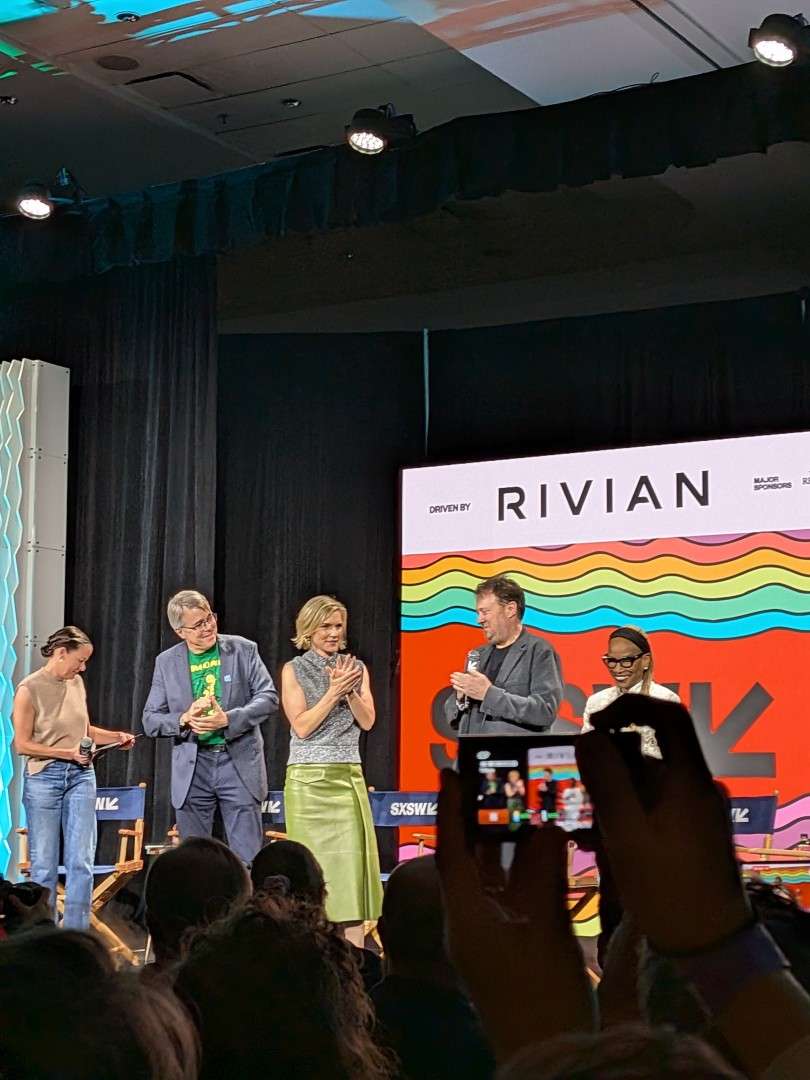
She added, “It’s about human nature, but it’s also about what it means to be human and redefining what the pursuit of happiness is. That’s the end‑all and be‑all. How do you define success, and how do you define love and relationships?” After praising co‑star Karolina Wydra’s acting (Zosia), she came back to her original point: “I don’t know what the show is about, and I love it.”
She recalled the years of doing press for Breaking Bad and joked, “What if it means, for God’s sake, just be more Sphinx‑like and that I have to shut up? There’s a lot of other people figuring out what it means.”
TRUST
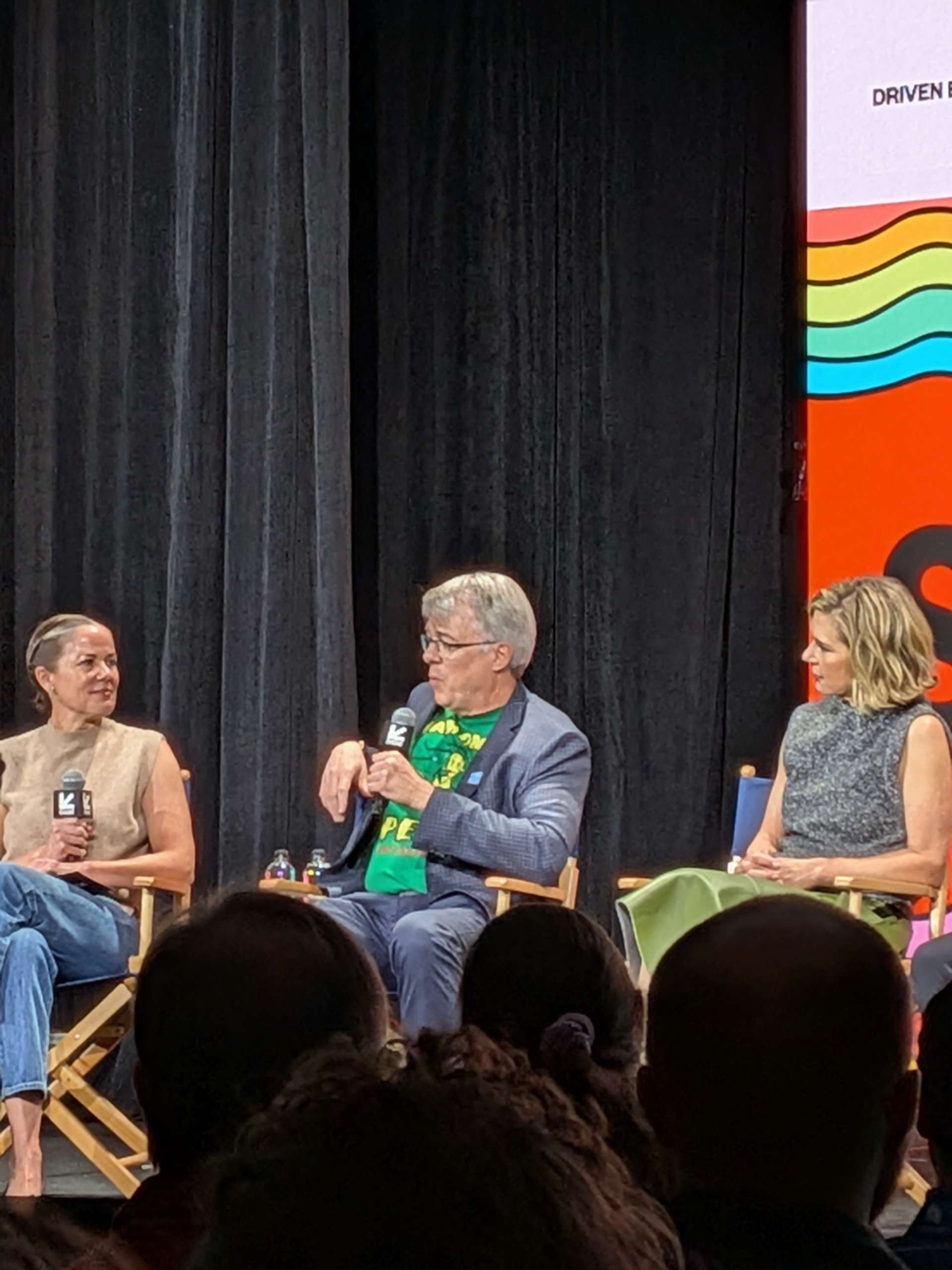
Interviewer, Vince Gilligan and Rhea Seehorn on March 14, 2026 at SXSW.
One of the most heartfelt moments of the panel came when Seehorn talked about the trust built inside this team. “There’s this thing that Vince does where he trusts the audience,” she said, “but it also involves the key trust of the performers. I trust his ideas. And one of the great gifts he’s given me is that he trusts mine.” Because of that trust, she said, she never feels the pressure to telegraph emotions. “He rids me of the onus to make sure the audience knows exactly what I’m thinking. I just have to think the thoughts and be true to the character. It frees me up to do a much more complex and nuanced performance, which a performer is not always allowed to do.”
PLURIBUS’ POPULARITY
When asked about the show’s positive reception, Seehorn admitted she didn’t see it coming. “It was so awesomely weird. I could never guess where it was going to go. We hoped we’d find an audience that gets it… but is it this niche thing? Is it going to be a cultish thing?” Instead, she said, “The broad audience reception blew me away… the popularity of it and its critical reception. For critics and fans to like the same show — you don’t always win that lottery.”
A ONE‑WOMAN SHOW
Much of Pluribus onscreen centers on Seehorn alone, often with minimal dialogue. She said she discovered this gradually: “It wasn’t like I saw the breadth of the whole thing and understood, ‘Oh, I’ll be doing an episode with almost no dialogue. Oh, I’ll be doing episodes almost by myself.’”
That intensity didn’t intimidate her, but she admitted the vulnerability of it: “There are days where I would read something that’s tomorrow’s and think, ‘Oh, today’s the day they find out that I was not very good.’”
SOUND AND MUSIC
Composer Dave Porter described how Pluribus forced the whole team to reinvent their musical approach. “This was a mandate to be different,” he said. “We took our creative process and re‑analyzed all the lessons we learned… and explored new territory.”Porter emphasized that the score had one job: “to be an assistant in storytelling,” adding emotion without dictating interpretation. That freedom, he said, is rare.
The biggest shift was using a live orchestra. “You can feel the human touch,” Porter said. “There’s no comparison between something that a computer can do and something humans can do.” Recording orchestral demos was new for Gilligan, but everyone “took a leap of faith” because they knew what that sound could bring. And New Mexico allowed them to keep the coyote yelps, which the entire onstage crew demonstrated in unison.
COSTUMES, JACKETS, AND ALBUQUERQUE

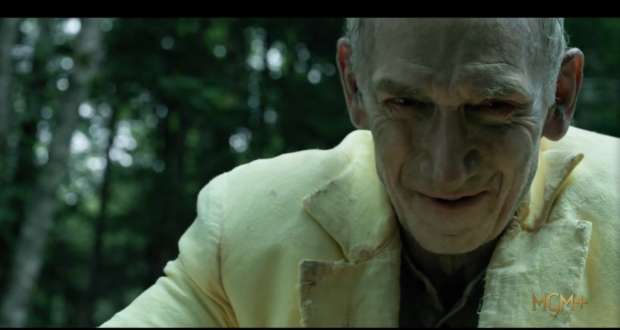
Jennifer Bryan offered an enthusiastic breakdown of the costume design — from practical brown tones to the much‑discussed yellow jacket with leather ordered from France. The guiding principle, she emphasized, was practicality: protection from the elements and movement that fit the scene’s physical demands, such as when Carol has to lift Helen’s body into her vehicle.
As for Albuquerque, Gilligan’s long‑running creative home, the return came down to three things: the spectacular clouds, the deeply collaborative crew, and the cost efficiency that makes ambitious storytelling possible.
CAROL, LIKABILITY, AND GRIEF
When asked how she makes an “unlikable” character into someone an audience roots for, Seehorn pushed back. “The term likable has gotten misused, particularly concerning female characters,” she said. “What matters is not likability but accessibility: Behaving truthfully and honestly in a moment.” She illustrated it bluntly through Carol’s point of view: “They killed my wife. My career is gone. I might die alone watching Golden Girls. I’m sorry I wasn’t chirpy.”
On Carol’s grief over Helen’s death and the ever-changing world around her, she said, “Getting up off the floor the next morning is heroic by itself. I very much enjoyed exploring what Carol’s anger over her wife was — her entire way of behaving halfway normal out in the world… She’s allowed to experience the full spectrum of human behavior, and now she’s being asked to suppress that.”
She hopes viewers connect to Carol not because she’s likable, but because she’s “honest and truthful and real… She’s holding nothing back.”