When a movie lingers with you long after the credits roll, it often comes down to the writing. Netflix’s Jay Kelly does exactly that. At its core the film is shaped by memory, regret, and the messy truth that no one is entirely good or entirely bad. During our conversation with writers Noah Baumbach and Emily Mortimer, the pair opened up about their writing process and the creation of some of the film’s most talked about lines. Their reflections reveal how deeply the story’s emotional ambiguity was crafted from the start.
The Meaning Behind Jay Kelly’s Most Memorable Line
One line has already become a favorite among audiences. It arrives during a moment of painful honesty. The character says, “You are Jay Kelly, but I am Jay Kelly too.” When asked whether the line was designed to invite multiple interpretations, Noah explained that its power came from the writing process itself rather than any overt intention.
According to Noah, the best lines only emerge when the writers are fully inside the scene. They do not design them as metaphors first. They create the world and the emotional landscape, then let the line arise from it. He said the moment came naturally because they were entirely inside the character at that point in the drafting process. He described it as an honest discovery rather than a calculated message. He added that the team never stops to force a single interpretation. They prefer lines that remain open because the film itself lives in moral gray areas. There are no perfect heroes or perfect villains. Every character carries reasons for their choices.
Emily agreed. She noted that some lines simply feel right without the writers needing to analyze why. She admitted that she did not expect viewers to single out that line, yet she understood immediately when they did. It had a quality that resonated even before they could articulate its meaning.
How the Ending Line Found Its Way into the Film

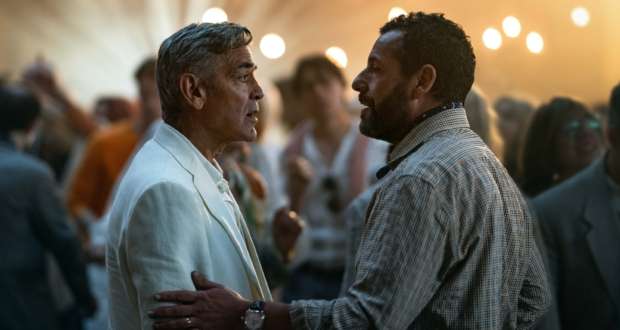
Jay Kelly. (L-R) George Clooney as Jay Kelly and Riley Keough as Jessica in Jay Kelly. Cr. Peter Mountain/Netflix © 2025.
The final moments of Jay Kelly leave the audience unsettled, hopeful, and uncertain all at once. After everything the character loses, the last line seems to awaken something inside him. When asked how they interpret the meaning of that final statement, Emily said it represents a memory that is unexpectedly sweet. Throughout the film Jay is forced to confront moments of guilt and regret. The ending allows him to return to a memory filled with tenderness. It reminds him that much of his life contained joy, even if he moved past those moments too quickly. She said the line captures the universal desire to revisit the best parts of our lives and live in them more fully.
Noah added another compelling layer. He said the line comes from his experience working with actors. In filmmaking, once a moment is gone, it is gone forever. An actor who says, “Can I go again” is often chasing a feeling or a truth they almost reached but did not fully capture. Noah sees the line as a metaphor for life itself. It expresses the hope that new possibilities still exist and that even after immense loss a person can discover a path forward.
Emily jumped in with a humorous observation that asking to go again usually means needing two more tries because the first attempt becomes too self-conscious. It is a moment that beautifully reflects how human the writing process is for this duo.
Why This Film Resonates So Deeply
The power of Jay Kelly lies not in simple answers but in its refusal to offer them. Noah and Emily designed the film around emotional contradiction. Memory is unreliable. People are flawed. People are loving. People heal in uneven ways. The script embraces all of this.
Their writing reflects a belief that the most compelling stories live inside tension. Jay loses many things, yet the final scene is carried by a sense of possibility. The film asks a daring question. What do you do when your past becomes your judge, yet your future still asks you to try again
Noah and Emily do not want to answer that question for the viewer. They want the audience to reflect on it. As Noah said, the ending must be open to interpretation because the character still has time left. The past cannot be rewritten, yet the future can.
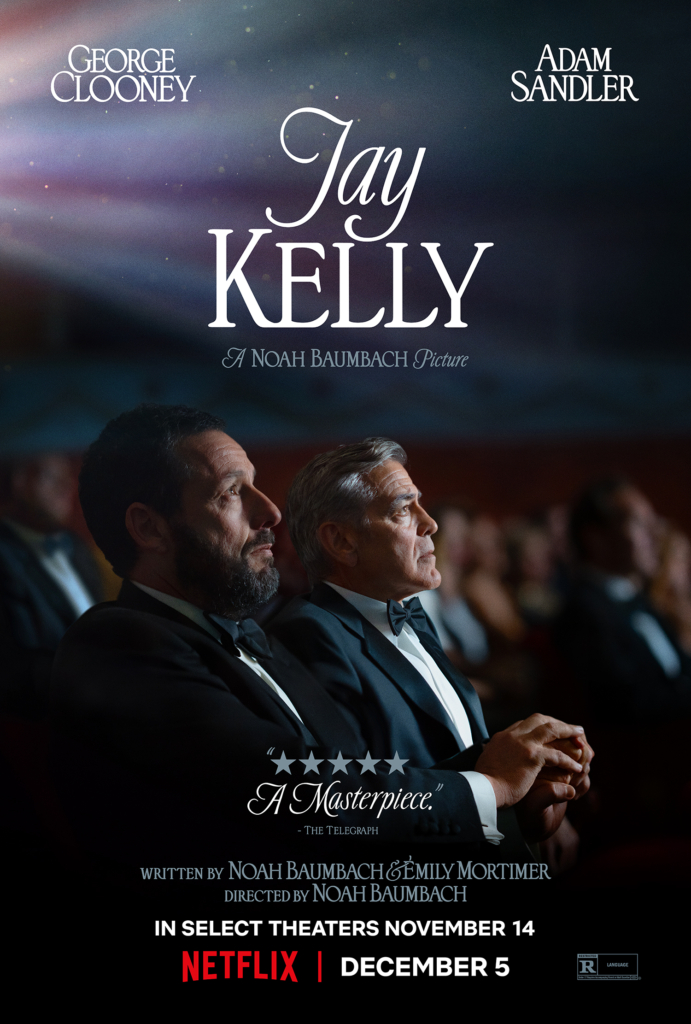
Director: Noah Baumbach
Writer(s): Noah Baumbach and Emily Mortimer
Stars: George Clooney, Adam Sandler, Laura Dern, Billy Crudup, Riley Keough, Grace Edwards, Stacy Keach, Jim Broadbent, Patrick Wilson, Eve Hewson, Greta Gerwig, Alba Rohrwacher, Josh Hamilton, Lenny Henry, Emily Mortimer, Nicôle Lecky, Thaddea Graham, Isla Fisher, Louis Partridge, Charlie Rowe
Jay Kelly comes to Netflix on December 5th, 2025. Be sure to follow E-Man’s Movie Reviews on Facebook, Subscribe on YouTube, or follow me on Twitter/IG @EmansReviews for even more movie news and reviews!