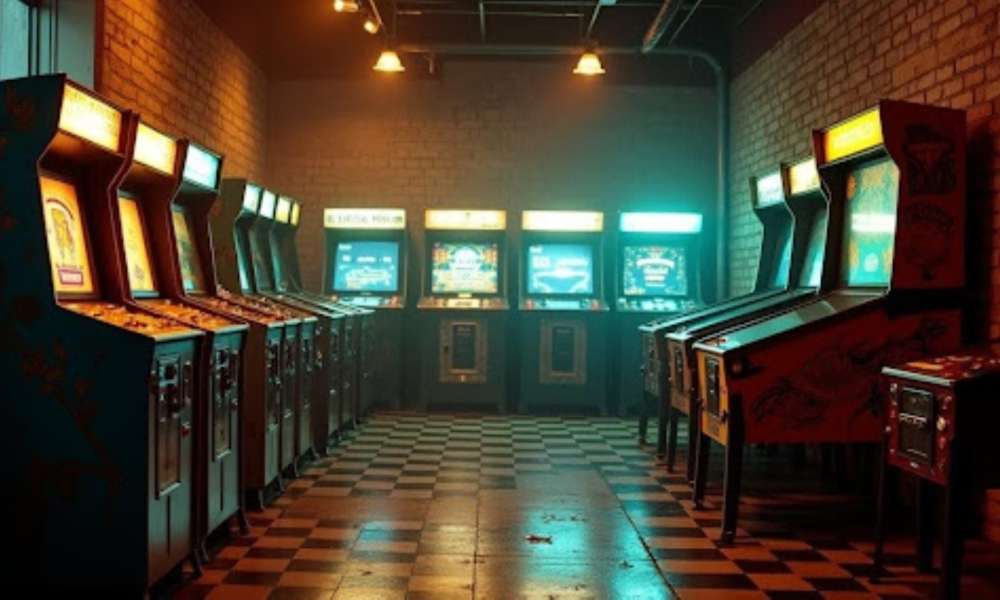

Enter a converted warehouse in Brooklyn or a strip-mall arcade in Austin in 2026, and you’ll find a familiar scene: glowing cabinets, the hum of old machines, and lots of youngsters who will never even imagine what arcades were originally. After years of being declared dead, arcades have returned as a lasting cultural fixture. They are not the noisy, coin-fed hangouts of the 1980s; they are a curated part of modern culture woven into bars, television, indie games, and the social habits of a generation raised online.
The revival has become so widespread that mainstream culture no longer treats arcades as a novelty but as a mood and visual language of its own. Modern films, for example, use arcades the way earlier generations’ cinematography used diners. Indie game studios now release pixel art titles that once would have looked outdated but are now seen as fascinating.
The reasons behind the resurgence are varied. Nostalgia plays a major role, but so does frustration with touchscreen gaming, fatigue from sprawling open world design and a growing desire for real social spaces where people can gather, compete and share an experience in person.
The revival is also reflected in the language digital entertainment platforms use to describe their own spaces. A reviews and predictions hub like Shurzy.com carries a section called Piggy Arcade, which leans on the same arcade-inspired vocabulary used in film and streaming to suggest a relaxed and casual play environment rather than a formal wagering space. That choice of language says a great deal about where arcade culture now sits in the mainstream, and the rest of this piece explores how the vocabulary of 1980s arcades evolved into a defining part of film, television and design culture in 2026.
How 1980s Cabinets Became a 2020s Cultural Reference
The classic American arcade peaked in the early 1980s. The home-console era marked its decline, which accelerated through the 1990s. What changed in the 2010s was not the cabinets but the people. A generation that grew up watching their older siblings play Galaga turned 30, started looking for places to spend a Saturday night that did not revolve around a phone, and discovered that pinball, fighting cabinets, and rhythm games scratched an itch that nothing online could touch. The result is the arcade phenomenon, originating with Brooklyn’s Barcade in 2004 and now repeated in close to a hundred American cities. The format is simple and the design language is consistent. Dim lighting, a chalkboard listing high scores, a row of vintage cabinets dating from 1979 to roughly 1994, and a craft beer list (that signals an adult audience rather than a child birthday party).
Stranger Things and the Streaming Era Rebuild of the Arcade Aesthetic
Streaming television did more for arcade nostalgia in five years than every retro magazine of the 2000s did in a decade, and the reason is simple. The arcade is photogenic, and a streaming drama with a strong visual identity can use its glow as shorthand for a whole decade. Stranger Things made the Palace Arcade a character in its own right, with Dig Dug and Dragon’s Lair cabinets shot like cathedral interiors. The Goldbergs leaned on a pizzeria full of Donkey Kong machines repeatedly. The reasons are that arcades date a scene to a precise window without further explanation. A child playing a game in a neon-lit corner of a small-town pizzeria is a one-shot character study, and the camera knows it.
How Stranger Things Tales from 85 Lands in the Same Visual Lineage
The streaming drama that frames this revival most explicitly in 2026 is the new Stranger Things spinoff, which leans even harder on cabinet imagery than the main show ever did. The thoughtful the Stranger Things Tales from 85 review on this site reads the season largely as a question of whether the show can recover the emotional texture of its first run, and the answer lands somewhere short of yes. What the review observes about set design and atmosphere is useful for the arcade conversation. The Palace Arcade is no longer a corner of Hawkins, and it becomes the visual center of the production. The cabinets are larger, the marquees brighter, the room more cluttered with sleeves of comic books and stacks of game manuals. Even when the writing wobbles, the art department is doing serious work to keep the spinoff inside the visual lineage that made Stranger Things, and the Goldbergs, and Hawkeye, and a dozen other prestige projects, reach for a cabinet whenever a scene needed to feel like the 1980s by lunchtime.
Pinball Came Back First and Stayed Loudest
Pinball is the part of the arcade revival that is easiest to underestimate and most important to take seriously. Stern Pinball, the only large American manufacturer to survive the 1990s, is now shipping new licensed tables roughly every quarter, with recent titles tied to Jaws, James Bond, Foo Fighters and Godzilla. American Pinball has built a stable line around horror licenses and original themes, and Jersey Jack Pinball ships premium machines that sell to private collectors for the price of a small car. The reason pinball, of all the arcade categories, returned first is mechanical. A pinball machine is a physical object. After fifteen years of touchscreen games where the physical interaction is minimal and standardized, the pinball cabinet feels like the world. That tactile difference is doing a lot of cultural work.
What the Verge Argued About the American Arcade and Why It Still Reads True
Long-form journalism on the arcade revival is patchy but not absent. The single most useful piece for understanding the cultural arc is the Verge feature on American arcades, which traced the rise, collapse and slow re-emergence of the format from its 1970s origins through the arcade era. The piece is more than a decade old now and reads even truer in 2026 than it did on publication. The argument was that arcades never really died; they shrank into a niche that turned out to be perfectly sized for adult nostalgia once the audience aged into it. What the piece could not have predicted in detail, but did predict in outline, is that streaming television, indie film and a generation raised on home consoles would each independently reach for the arcade as a memory anchor. The piece is essentially a road map for everything the 202 s did with arcade imagery, and it surely remains the best single starting point for anyone trying to read the comeback as more than a fad.
Indie Game Studios Borrowed the Arcade Look and Made It a Genre
The indie game scene of the 2010s and 2020s did something interesting with the arcade. It did not merely emulate old games; it took the visual grammar of cabinet art, attract modes and title screens and built whole new genres around them. Studios like Vlambeer, Devolver Digital, Housemarque and Yacht Club Games shipped releases with pixel-perfect typography, looping menu music and high-score chimes that read straight out of 1986. Shovel Knight, Cuphead, Returnal and Tetris Effect all owe something to cabinet aesthetics. What the indie scene proved is that the arcade is not just a piece of furniture but a design philosophy. It rewards a single short session, a clear high-score loop and a visual identity confident enough to fit on a marquee. Modern indie design treats those constraints as creative resources to create something primitive but somehow refined.
Why the Comeback Pulled Pop Culture Toward Cabinets Rather Than Consoles
It is worth asking why the nostalgia wave settled on arcades specifically rather than home consoles, given that the home-console era ran in parallel and produced far more individual memories per household. Part of the answer is social. A cabinet is a public object, and a public object photographs better than a private one. Production designers and bar owners alike can stage a cabinet, and a Nintendo Entertainment System in a wood-veneer cabinet from 1989 simply cannot do that work. The ot er half is aesthetic. Arcade games of the 1980s were built to attract a player from across a room, with big high-contrast sprites and saturated palettes designed to read at fifteen feet through a haze of cigarette smoke. Home-console games of the same era were scaled down for a television and a couch. When the 2020s went looking for retro imagery to borrow, the arcade catalogue offered better material on every front.
The future of the Arcade Revival
The honest answer is that the cabinet is now permanent. The “barcade” format is built into the urban entertainment template of every mid-sized Anglo-American city. Pinball has a healthy new-machine market for the first time since roughly 1992. Streaming television has made the cabinet a stock prop the way the diner used to be. Independent game developers have absorbed cabinet design into their default visual vocabulary. We should expect more virtual-cabinet releases on home platforms, and more recreational places that offer a craft beer list and Time Pilot machine. The cabinet has earned a permanent seat at the cultural table, and a generation that never saw it the first time around has decided, deliberately, that they want it back.