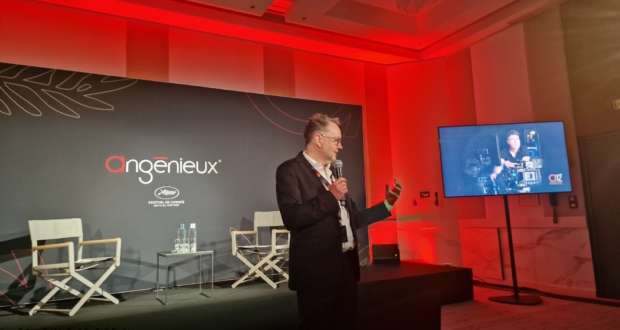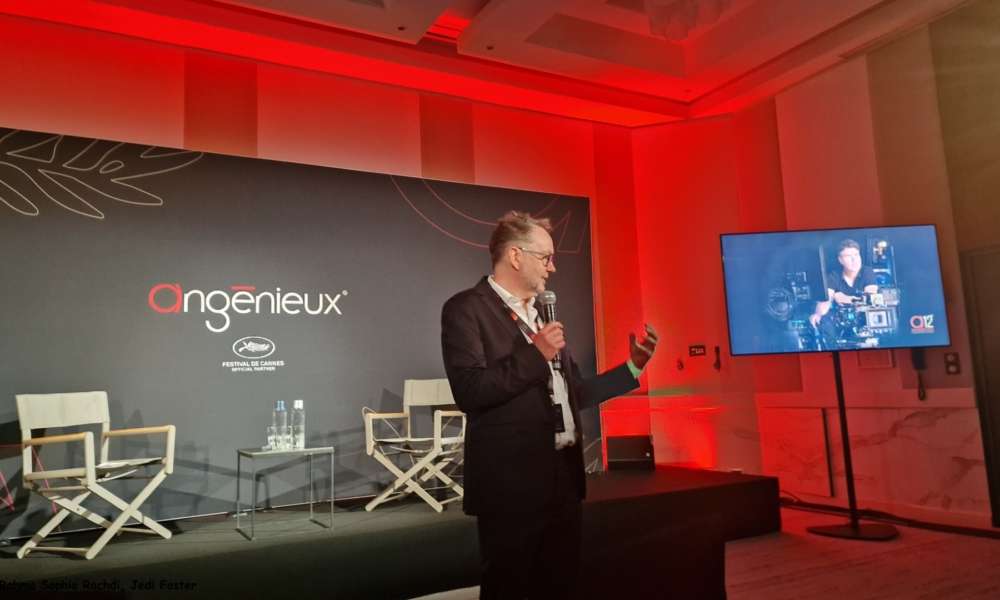

As a mobility-impaired journalist and Cannes Film Festival correspondent, I had the pleasure of attending the Pierre Angenieux Masterclass with cinematographer Dion Beebe (A.C.S., A.S.C.), held at the fully accessible and handy-friendly Hotel Gray d’Albion. The hotel offered an exceptional welcome, perfectly suited for wheelchair users, which made attending this important cinematic moment a smooth and dignified experience.
Dion Beebe the Australian director of photography celebrated for his work on Memoirs of a Geisha, Chicago, Collateral, and the upcoming Michael Jackson biopic, was honored with the prestigious 2025 Pierre Angenieux Tribute. The masterclass was a genuine, intimate, and technical conversation hosted by The Hollywood Reporter’s Jordan Mintzer, during which I had the opportunity to ask Dion Beebe a question about his relationship with Artificial Intelligence
and its implications for cinematography today.
The full transcript of this conversation is presented below, unedited in its essence, raw, and rich, capturing the spontaneous, honest, and sometimes humorous energy of this unique cinematic encounter. A second article will follow, covering the tribute ceremony itself.
CONCLUSION: THE COSMIC LENS OF A MASTER D.O.P.
If Dion Beebe’s career were a movie, the tagline might be something like: “When vision meets serendipity, genius happens.” Because let’s face it this guy didn’t just hustle his way into Hollywood with a camera strapped to his back. No, his journey reads like the universe had a storyboard of its own.
Think about it. A kid who questions whether long commercial shoots are his future suddenly finds himself lighting up Broadway legends in Chicago and chasing the poetry of shadows in Memoirs of a Geisha. He doesn’t force doors open he shows up, camera-ready, heart humble, and the right door opens at exactly the right moment.
This is a guy who got a call on a Friday afternoon to meet Michael Mann. Who met Jane Campion and, from that spark, lit up an entire filmography. Who embraced digital filmmaking before it was sexy and turned chaos into controlled beauty. Even his real-life plot twists (like his wife sharing a name with rising Korean talent EUNSOO CHO) feel too cinematic to ignore.
What sets Beebe apart isn’t just his talent it’s his capacity to listen to the project, the director, the moment. Whether it’s dancing with shadows on set or negotiating with Mother Nature herself (hello, fake seasons in sunny L.A.) he crafts images not just to dazzle, but to serve the story’s soul. And now, full circle. Back on the Croisette. Back in Cannes. Award in hand. The Pierre Angénieux Tribute is more than a trophy it’s a cosmic wink. As if the universe said, “Remember that 22-year-old kid in 1992? Look what happens when you trust your lens, trust your path, and light your own damn way.”
FULL TRANSCRIPT OF MASTERCLASS WITH DION BEEBE

Jordan Mintzer (The Hollywood Reporter)
We’re gonna go through some of your work. And then we’ll take some questions from the audience. And again, congrats on the award, and it’s great to have you here.
Dion Beebe
Thank you very much. It’s great to be here.
Jordan Mintzer
So, I guess the first question I wanna ask you is, I read that when you were quite young, you were already on set, because your dad was a designer?
Dion Beebe
Yes, yes, my dad worked in theatre — set design — so when I was a kid growing up in South Africa, I spent a lot of time in theatre, backstage. And it was always a very creative environment. It was always a lot of fun, and, yeah, I think, you know, I think that really was a big influence for me in terms of my career path.
Jordan Mintzer
So, you grew up in South Africa, and then at what point did you move to Australia?
Dion Beebe
I was 18 when we left. Actually, we went to New Zealand first for a year, and then we moved to Australia. So, I was probably 19 when we arrived in Australia, and then I went to film school in Sydney. So that was where I kind of started my career.
Jordan Mintzer
And how did you get into cinematography? Was that something you knew about already, or did you discover it?
Dion Beebe
You know, I think I always was interested in images and storytelling, and I started at film school actually doing editing. I had a love of editing. But I kind of fell in love with cinematography. And I think it was the visual storytelling, the kind of immediate results that you got, you know, being on set, working with people. You know, editing is a very solitary job. So, I think for me, I found a kind of energy in cinematography that I really responded to.
Jordan Mintzer
And how did you sort of break into the business after school?
Dion Beebe
I was very lucky. When I left film school, I started working as a camera assistant, and then I started shooting a lot of commercials. And, you know, Australia is quite a small film industry, so it’s kind of very connected, and I was very lucky to start shooting features fairly young. I shot my first feature at 25 or 26, and then it just kind of built from there.
Jordan Mintzer
And when did you start working internationally?
Dion Beebe
It was probably… I guess around the late ’90s. I did a film with Jane Campion — I don’t know if you know Holy Smoke, with Kate Winslet and Harvey Keitel — that was probably the first film I did that had an international release. And that was really my stepping stone into working in the US and elsewhere.
Jordan Mintzer
How did you end up working with Rob Marshall on Chicago?
Dion Beebe
It’s kind of a funny story. I got a call from my agent on a Friday, and he said, “They’re doing this musical in Toronto. They’re looking for a D.P. Can you go up and meet with the director?” So I flew up to Toronto on Saturday, met with Rob, and we just hit it off. We had a great meeting, and he offered me the job. So I had to move to Toronto on Monday.
Jordan Mintzer
That’s fast.
Dion Beebe
Very fast, yes. But, you know, it was one of those moments where you meet someone and just connect. And we had a great collaboration. That was the beginning of a long working relationship.
Jordan Mintzer
And what was it like doing a musical like that, which kind of reinvented the way musicals were shot?
Dion Beebe
It was an incredible experience. We were really trying to find a way to translate the energy of a stage musical into a cinematic language. And Rob came from theatre, so he had a very strong vision of what he wanted. We worked very closely together — especially in pre production — to plan the camera moves, the lighting, how to support the choreography. It was a very integrated process.
Jordan Mintzer
I mean, it’s very stylized. Did you have a visual reference for that film?
Dion Beebe
Yeah, we looked at a lot of classic film noir, a lot of old musicals. But really, we were trying to
create something unique. We wanted it to feel like it had one foot in the past and one foot in the present. So, the lighting is very theatrical at times, but also quite modern in the way we used the camera.
Jordan Mintzer
And it won you an Oscar?
Dion Beebe
It did. That was a surprise, honestly. I mean, it was such a big film, and there were so many elements that had to come together. But I think we managed to create something that people really responded to.
Jordan Mintzer
I’d love to show a clip now from Memoirs of a Geisha, which is a very different film from Chicago. Tell us a bit about making that one.
Dion Beebe
That was a dream project. The design, the costumes, the sets — everything was just stunning. We shot a lot on sound stages, and it was very controlled. It was almost like painting with light every day. I got to work with a great team, and it was just a very special film to be part of.
Jordan Mintzer
You also worked on Collateral with Michael Mann, which was one of the early digital films. How was that?
Dion Beebe
That was a big change. We shot almost entirely with digital cameras at night, in Los Angeles. At the time, it was quite new to shoot a feature like that digitally. Michael wanted to capture the city in a way that film couldn’t — the lights, the atmosphere. It was a big learning curve, but very rewarding.
Jordan Mintzer
And now you’re working on a new biopic about Michael Jackson?
Dion Beebe
Yes, we’re in the middle of that now. It’s a huge project very ambitious. We’re trying to tell the story in a way that’s both respectful and visually compelling. It’s still in progress, so I can’t say too much, but I’m very excited about it.
Audience Q&A – including a question on AI from Rahma Sophia Rachdi
Rahma Rachdi (in the audience)
Thank you, Mr. Beebe, for this inspiring masterclass. As a journalist closely following the evolution of Artificial Intelligence in filmmaking, I wonder: what is your relationship with AI today? And how do you think it will influence the work of a cinematographer?
Dion Beebe
That’s a great question. I think AI is definitely going to change the landscape. In some ways, it already has. We’re using AI-based tools in postproduction, for example, in color grading and image enhancement. But for me, cinematography is still very much about human connection’s about being on set, reading the mood, working with actors and directors in real time. I don’t think AI will ever replace that. But it can be a great support tool.
During this rich and insightful masterclass, I had the opportunity to ask Mr. Dion Beebe, one of the most celebrated and sought-after Directors of Photography of his generation, both in Hollywood and internationally a question about Artificial Intelligence and its impact on cinematography. Renowned for his long-standing collaborations with acclaimed filmmakers and for his visually groundbreaking work, Dion Beebe is a multi-award-winning D.O.P., whose accolades include an Academy Award and numerous prestigious recognitions. Most recently, he was honored at the Cannes Film Festival with the distinguished Pierre Angénieux Tribute, which celebrates excellence in cinematography.
Although his response has not yet been shared publicly, I felt this question which reflects one of today’s most pressing concerns deserved to be posed to such a high-profile figure. His more specific answer will be published in a forthcoming article via our agency. In the meantime, here is the transcript of my question, along with a thoughtful, anticipatory take on this crucial topic. To be continued…
THE AI STORY IN FILM MAKING FORM SC-FI TO SHOWTIME
Let’s roll it back: AI isn’t some sci-fi movie plot cooked up yesterday. Nah, it all started back in 1956, at the Dartmouth Conference where a bunch of brainiacs sat around and said, “Hey, what if machines could think?” Boom, Artificial Intelligence was born.
Fast forward, and AI slowly crept into our lives, mostly behind the scenes like a ninja helping out in post-production. You know those fancy color corrections? AI’s got your back. Image enhancements? AI’s the quiet hero.
The real Hollywood AI moment came in 2018, when “Zone Out” (okay, a fictional example here, but stay with me) became the first fully AI-generated short film. On the real side, AI started popping in as a tool think “The Irishman” (2019) where AI-assisted de-aging tech blew minds, or the stunning VFX in Marvel blockbusters.
And hey, don’t forget 3D! The first major 3D film dates way back to 1952 with “Bwana Devil,” but the real digital 3D boom happened with “Avatar” (2009), directed by James Cameron in New Zealand, changing the game forever…