
In the ever-expanding landscape of digital-age thrillers, American Sweatshop stands out as an intriguing attempt to explore the moral and psychological weight of online content moderation, a job that most audiences know exists but rarely think deeply about. Directed by Uta Briesewitz and written by Matthew Nemeth, the film blends elements of a mystery thriller with a slow-burning character study, carried by a central performance from Lili Reinhart that is both empathetic and unnerving. With Barry Levinson and Tom Fontana backing the project as producers, the film aspires to be more than a surface-level “tech-noir” and instead grapples with the unseen consequences of living in a digital society where horrors are streamed rather than whispered.
The film tells the story of Daisy Moriarty (Reinhart), a content moderator tasked with purging offensive media from social platforms. Daisy’s work is repetitive and numbing—hours spent watching the worst humanity has to offer—but when she stumbles upon a video that appears to document a real violent crime, the boundaries between her professional detachment and personal responsibility collapse. Convinced that what she witnessed is not just another piece of disturbing fiction or staged content, Daisy begins to dig deeper, abandoning the safety of her computer screen to trace the origins of the video. What follows is a descent into paranoia, obsession, and moral ambiguity, as Daisy questions whether she’s uncovering a hidden crime or simply unraveling under the psychological weight of her work.
The World of Moderation: A Compelling Hook:
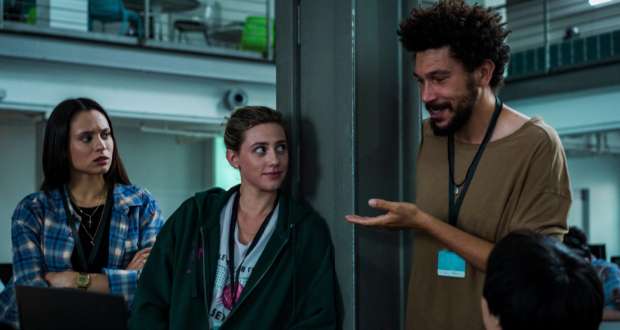
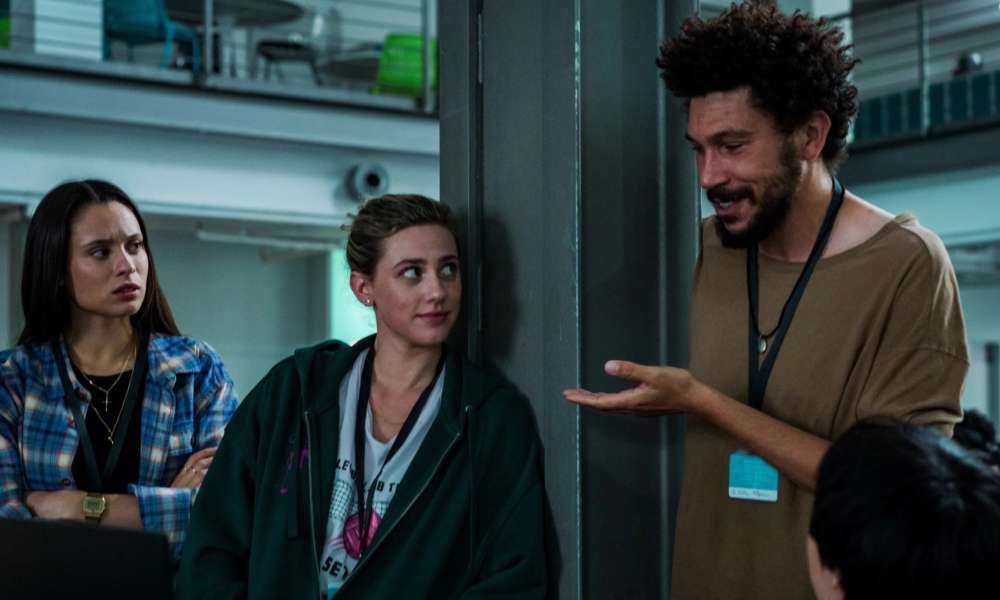
Briesewitz’s direction thrives most in the early acts, where she immerses us in the sterile yet suffocating environment of Daisy’s workplace. Rows of employees sit in dimly lit cubicles, staring at screens filled with the detritus of the internet. Daniela Melchior’s Ava Alvim, Daisy’s co-worker and friend, tries to keep things light with gallows humor, while Joel Fry’s Bob distracts himself with banter that masks his own weariness. Jeremy Ang Jones as Paul adds another layer, portraying the kind of jaded cynicism that comes with too much exposure to digital brutality. Christiane Paul, as Daisy’s boss, represents the corporate machinery—sympathetic enough to acknowledge the toll but pragmatic enough to insist the work must continue.
This setting works well as a metaphorical “sweatshop” for the internet age: a place where human beings, underpaid and unseen, sift through the chaos of the online world so others don’t have to. The film lingers on the psychological toll of this work, showing Daisy’s insomnia, her compulsive rewatching of flagged clips, and her creeping inability to distinguish between real violence and fabricated gore. This ambiguity becomes the film’s thematic engine.
A Nuanced Core:
Lili Reinhart’s performance as Daisy is the film’s strongest asset. Known primarily for lighter or romantic roles, Reinhart here displays impressive range, embodying a character whose compassion fuels her obsession. Daisy is fragile but determined, haunted but unwilling to let go. Reinhart captures the exhaustion of someone whose empathy is both her strength and her curse. Even when the narrative occasionally wavers, Reinhart’s grounded work keeps the film compelling.
Her chemistry with Melchior’s Ava provides necessary warmth in an otherwise bleak environment. Their conversations—half jokes, half confessions—offer glimpses of humanity and solidarity. Ava serves as both Daisy’s confidante and her tether to normalcy, a tether that inevitably strains as Daisy goes deeper into her quest. Joel Fry, meanwhile, adds levity but also tragic weariness, a reminder of how long-term exposure to digital horror erodes one’s psyche.
Mystery and Tension:
The central mystery—was the crime Daisy witnessed real, and if so, can it be solved?—unfolds in fits and starts. Briesewitz stages several tense sequences: Daisy tracking addresses, visiting shadowy online forums, and eventually venturing into physical spaces connected to the video’s origins. The suspense escalates in a deliberate, slow-burning fashion, trading flashy action for creeping dread.
However, the pacing sometimes works against the film. Certain middle-act stretches linger too long on Daisy’s repetitive sleuthing, with the story circling rather than progressing. While this reflects the numbing grind of her work, it occasionally stalls narrative momentum. The climax does deliver a satisfying escalation, though it avoids the kind of explosive resolution audiences might expect from a conventional thriller. Instead, it leans into ambiguity and moral discomfort, which fits the film’s themes but may leave some viewers unsatisfied.
Themes and Social Commentary:
What American Sweatshop does best is raise questions without easy answers. It highlights the hidden labor force that protects digital spaces, the mental health consequences of that work, and the blurred line between professional duty and personal responsibility. Daisy’s journey forces us to confront whether being exposed to humanity’s darkest impulses makes one more vigilant—or simply more broken.
The film also critiques corporate indifference, showing how Daisy’s concerns are often dismissed as overreactions or misinterpretations. Her boss acknowledges her stress but frames it as an inevitable cost of doing business. This tension—between the human cost of moderation and the profit-driven need to maintain platforms—gives the film a sharp, socially resonant edge.
Briesewitz’s Direction and Atmosphere:
Visually, Briesewitz employs a cold, muted color palette that mirrors the sterility of Daisy’s environment. Screens glow ominously in dark rooms, reflecting Daisy’s face as if trapping her in a digital cage. The sound design amplifies the tension, with distorted audio from flagged videos bleeding into Daisy’s daily life. These stylistic choices create an atmosphere of unease, effectively blurring the boundaries between Daisy’s work and her unraveling perception of reality.
Yet, the film occasionally leans too heavily on style over substance. Certain sequences indulge in overly abstract imagery—dreamlike montages of glitching screens and bloodied visuals—that feel more like arthouse flourishes than necessary storytelling. While they underscore Daisy’s mental collapse, they can also distract from the grounded realism that makes the film most compelling.
Overall:
American Sweatshop is not a flawless thriller, but it is an important one. It succeeds in drawing attention to the invisible labor of online content moderators and in exploring the psychological costs of constant exposure to digital violence. Reinhart delivers a career-highlight performance, anchoring a story that might otherwise falter under uneven pacing and occasional stylistic excess.
As a mystery, the film intrigues without fully satisfying; as a character study, it resonates deeply. Its willingness to end on ambiguity may frustrate some, but it also stays true to its unsettling themes. In the end, American Sweatshop works best as a haunting meditation on empathy in an era of endless digital cruelty.
Briesewitz and Nemeth don’t offer clear solutions, but they do shine a light on a world few consider—one where real people absorb society’s darkness so others can scroll freely. For that, the film earns both respect and attention, even if it doesn’t always deliver the tightest thrills.
American Sweatshop Review: A Tense Digital-Age Thriller
-
Acting - 7.5/10
7.5/10
-
Cinematography/Visual Effects - 6.5/10
6.5/10
-
Plot/Screenplay - 7/10
7/10
-
Setting/Theme - 7/10
7/10
-
Watchability - 7/10
7/10
-
Rewatchability - 4/10
4/10
Overall
Summary
Briesewitz and Nemeth don’t offer clear solutions, but they do shine a light on a world few consider—one where real people absorb society’s darkness so others can scroll freely. For that, the film earns both respect and attention, even if it doesn’t always deliver the tightest thrills.
Pros
- Lili Reinhart brings depth, vulnerability, and determination to Daisy, grounding the story
- Focuses on the underexplored world of content moderation and its psychological toll
- Cold, sterile visuals and eerie sound design heighten the film’s unsettling mood
- Daniela Melchior, Joel Fry, and Christiane Paul add texture and humanity to the workplace dynamic
Cons
- Middle sections drag with repetitive sleuthing, stalling narrative momentum
- Occasional dreamlike or abstract sequences feel more distracting than effective
- Thematically consistent but may leave some viewers unsatisfied, lacking a definitive payoff
Summary: American Sweatshop is not a flawless thriller, but it is an important one. It succeeds in drawing attention to the invisible labor of online content moderators and in exploring the psychological costs of constant exposure to digital violence. Reinhart delivers a career-highlight performance, anchoring a story that might otherwise falter under uneven pacing and occasional stylistic excess.