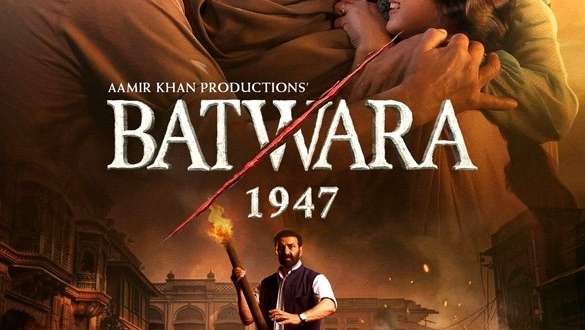
The “Dhai Kilo Ka Haath” is back! But this time, not to bash up Pakistan, but to go and settle there! You read that right. For the first time in Hindi cinematic history, the He-Man of Bollywood, Sunny Deol, transforms into a Muslim character who was forced to leave mainland India and move to the newly formed Islamic nation of Pakistan during the 1947 partition era.
Titled “Batwara 1947”, translated as “Partition 1947”, this Hindi-language period drama debuted in theaters on the eve of India’s Independence Day 2026. The film stars Sunny Deol opposite Shabana Azmi, Preity Zinta, Karan Deol, and Abhimanyu Singh. It has been produced by Aamir Khan and directed by Rajkumar Santoshi.
Batwara 1947: When The Radcliffe Line Divided India Forever!
Batwara 1947 (2026) Synopsis: Humanity Sustains Amidst Division!
It’s 1947, and the British, before leaving India, had divided the country into two: India and Pakistan. As per the deal, India belonged to Hindus and Pakistan to Muslims. This upheaval led to immense chaos and hostilities, with millions of people shifting in both countries.
This is the story of a Muslim family who were forced to migrate from India to the newly formed nation of Pakistan amidst heartbreak and a world divided by hatred and fear. With rising tensions, the film portrays their courage, compassion, and resilience to survive.
“Har Insaan Ka Pehla Mazhab Maa Hain” — Batwara 1947 (2026) Official Trailer:
The Good:

When Evil Threatens His Family, He Rises Like A Storm! Starring Bollywood’s He-Man, Sunny Deol as Sikander Mirza in Batwara 1947
The screenplay of Batwara 1947 is gripping, and you won’t be able to take your eyes off this intense period drama for a second. As the tense incidents unfold, you will get attached to the slow-burning and intricate family emotions as well as be startled by the building tensions and tumult.
The plot is inspired by real events during independence when India split up, and Pakistan came into existence. Muslims had to leave mainland India and were forced to move to Pakistan. Similarly, the Hindus who were residing in Pakistan were forced to leave for India. In the turmoil, where millions of uprooted and devastated refugees had packed up in both countries and were seeking accommodations, this story narrows down its theme to the city of Lahore in Pakistan, where a wealthy Muslim factory owner named Sikander Mirza (Sunny Deol) moved with his family from Meerut, India.
In their allotted mansion, the family finds an old and haggard Hindu woman named Durgavati (Shabana Azmi), who was the actual owner of that mansion and was left behind waiting for her lost son. Initially, she accuses Sikander and his family of trespassing on her property. Sikander retaliates with the determination to get rid of her. However, slowly the family builds a bond of love and compassion towards her. The tensions that build up in their Muslim locality, which opposed a Hindu woman staying back in Pakistan, and how Sikander Mirza cared for her and protected her from her bloodthirsty enemies will evoke sympathy in you.
In Times Of Hatred and Fear, He Chose Courage: Starring Sunny Deol As The Daredevil Sikander Mirza in Batwara 1947!

Abhimanyu Singh as Sikander’s rival, Yaqoob Khan, the lead antagonist in Batwara 1947
Batwara 1947 tells us that humanity is the first and foremost religion. Sikander Mirza, being a Muslim, had a change of heart and considered Durgavati as his own mother. He opposed anybody who came in his way, saying, “She is my mother, and a mother doesn’t have any religion. A mother is a mother only”. He endured humongous rivalry, threats, and horrific physical confrontations from his Muslim community in Lahore, but stood his ground. This tells us about the strong bond of love a son can have for his mother. Irrespective of a mother’s religion, the son will always care for her and protect her from societal evil.
It was indeed unexpected of Sunny Deol to come out with such a character. His character development in Batwara 1947 is completely opposite to his past films. Here he travels to Pakistan, no doubt, like he did in many of his previous movies. But here he goes as a Muslim immigrant to oppose the orthodox ideologies of Muslims in the region. He has carried out his role with utter commitment and left no stone unturned to embrace the aura of his righteous and daredevil character, Sikander Mirza. And I have to say, I have gained sound respect for this character, which he played in this movie. The altruistic Sikander Mirza is indeed an inspiration to this selfish world plagued with communal hatred.
Presenting Sunny Deol as Sikander Mirza and Shabana Azmi as Durgavati In Batwara 1947

Sunny Deol’s real-life son, Karan Deol, as his reel-life son Javed Mirza, with Kanikka Kapur as his love interest and Yaqoob Khan’s sister, Nishat Khan
Preity Zinta as Sikander’s wife, Hamida Mirza, makes an emotional comeback after being out of the film line for a very long time. She has appeared beautiful and pleasing in her character. Shabana Azmi is the lead actress in Batwara 1947, and she remarkably brings justice to her distressed old Hindu woman character residing in a Muslim world. It is indeed surprising to see her in two back-to-back films, Awarapan 2 and Batwara 1947.
The intriguing screenplay of Batwara 1947 is filled with emotional dialogues that hit the heart. The climax scene is deeply emotional to leave you in tears. The cinematography and sets are retro and aesthetic, clearly depicting the city of Lahore as it was during the 1947 era. The editing was sharp with no loose moments. Although this is not a hardcore action film, certain short action scenes appeared powerful.
The Bad:
I must remind you that the theme of Batwara 1947 is highly sensitive and may evoke religious hostility and adverse emotions in certain instances. It can be discomforting to watch with a Muslim friend if you are a Hindu, or a Hindu friend if you are a Muslim.

Sunny Deol (Right) with Karan Deol (Left) in a still from Batwara 1947
In certain initial phases of the screenplay, Sikander Mirza and his family acted abusively against Durgavati when they bumped into her for the first time. They just wanted to drive Durgavati away from Pakistan by any means. This can look direly unconvincing for a hero like Sunny Deol to least care about the well-being of a vulnerable old woman who is waiting for her lost son. Because in all of his past movies, Sunny Deol has always played heroic characters who respect and are compassionate towards older people in distress. So, such rude behavior towards a helpless old woman on his part during the initial parts of the screenplay may seem unacceptable. It was a bit shocking to see our ideal hero that way.

Moreover, Sunny Deol’s real-life son, Karan Deol, plays his reel-life son in Batwara 1947. His negative character appears hidden under his father’s shadow. Honestly, it seems like he will never ever be able to match the roaring aura of his father. Not just Karan, but the personality of the lead villain Abhimanyu Singh, who plays Sikander’s rival Yaqoob Khan, diminishes in front of Sunny’s machismo. Abhimanyu’s role was direly unconvincing. He pursued some futile activities from time to time, like trying to forcefully occupy Sikander’s mansion, negatively influencing Sikander’s son, suddenly running for politics, and wasting his valuable time and energy on driving out an old woman from Pakistan. These actions carried out by his character are shown haphazardly.
The Emotional Prayer “Kahaan Chale Gaye Ho Ram” From Batwara 1947

Presenting Preity Zinta as Sikander’s wife, Hamida Mirza
Even the storyline had a loophole regarding Abhimanyu’s villainous Yaqoob Khan character. Yaqoob was aware that Durgavati’s son and his family were killed in the riots. He could have informed her about it. His efforts to destroy Durgavati and drive her out of Pakistan could have been easily successful then. But he never gave the news of her son’s death. This looks logically absurd.
Batwara 1947 was initially titled Lahore 1947. But due to certain controversies, producer Aamir Khan had to rename it. I honestly feel the name “Lahore 1947” would have suited this period drama. This is because this film actually narrows the theme of the partition of India and Pakistan to the city of Lahore. However, controversies prevail in the filmmaking world. People might object if an Indian film is named after a Pakistani city. This might be the actual cause for the renaming of this film.
To be honest, the backdrop of Batwara 1947 indicates the events during the partition of India and Pakistan in 1947, which should have been a big storyline in itself. A few broader incidents that occurred during the partition are covered sporadically. But since the drama mainly concentrates on just an old Hindu woman not wanting to leave the new Islamic nation of Pakistan, the title of the movie seems unjustified for its plot. “Lahore 1947” seems a better fit.
The Romantic Track “Tabassum” Featuring Ali Fazal and Isha Sandhir From Batwara 1947
The Verdict: An Emotionally Engaging Period Drama!

Featuring Shabana Azmi as Durgavati
Batwara 1947 has been adapted from the stage play “Jis Lahore Na Vekhya, O Jamya E Nai”, translated as “The person who has not seen Lahore has not even been born”, by playwright Asghar Wajahat. Even if there are a few loopholes, after many years, I am seeing a Bollywood film that is not a remake of any Hollywood or South Indian movie. The unique script adapted from a stage play gives Batwara 1947 a fresh take.
Even though Batwara 1947 is a beautifully scripted historical drama, the protagonistic characters are a middle-aged man, Sikander Mirza (Sunny Deol), and an old woman, Durgavati (Shabana Azmi). So, such a mature-themed film with older characters may not appeal to the younger sections of the audience. They may find it outdated and boring. Moreover, as the theatrical release of Batwara 1947 clashed with the Emraan Hashmi-starrer Awarapan 2, it simply got belittled in front of the massive craze for the latter.
Whatever may be the case, Batwara 1947 is a monumental awareness film about humanity. The film ends with the quote “Maa Se Bara Koi Karam Nahi Hota, Insaniyat Se Bara Koi Dharam Nahi Hota”, meaning “No karma is greater than a mother, and no religion is above humanity”. It tells us that irrespective of whatever religion you may practice, you must practice humanity first. It also signifies that the bond of love between a mother and son is devoid of any boundaries or religious conflicts. This is a must-watch family drama if you share a deep interest in the 1947 Partition of India.
Brace Yourselves For The Roar Of Sunny Deol In Batwara 1947: One Of The Most Turbulent Chapters In The History Of The Indian Subcontinent!

-
Acting - 8/10
8/10
-
Cinematography/Visual Effects - 10/10
10/10
-
Plot/Screenplay - 7/10
7/10
-
Setting/Theme - 6/10
6/10
-
Watchability - 8.5/10
8.5/10
-
Rewatchability - 4.5/10
4.5/10
Overall
Feel the Pain of The Partition In “Batwara 1947”!
When borders and religious bigotry divide, they divide humanity as well. Amidst rising communal hatred, a hero (Sunny Deol) emerges as a son to protect his sworn mother (Shabana Azmi) belonging to a different religion.
Pros
An emotionally engaging and fresh family drama with a screenplay filled with rising tensions, chaos, and religious hostility
Sunny Deol’s stellar acting, coupled with his roaring personality and machismo
Shabana Azmi’s impactful performance
Powerful short action sequences
Retro and aesthetic visuals and sets
Sharp editing
Cons
The title of the film indicates a broader theme, which is the partition of India and Pakistan, while the plot is mostly set in the Pakistani city of Lahore
Sensitive theme that may evoke hostile religious feelings
Certain parts of the screenplay appeared logically unconvincing
The lead antagonist played by Abhimanyu Singh failed to match up to Sunny Deol’s roaring aura
Being a mature theme, the film may not appeal to younger generations who usually prefer funky movies